Wyandotte County reported a cumulative total of 4,740 COVID-19 cases on Thursday, an increase of 67 cases since Wednesday, according to the Unified Government COVID-19 webpage. There were a cumulative total 98 deaths, an increase of two deaths since Wednesday.
The Wyandotte County population has been hard hit by COVID-19, both by the illness and also by unemployment that resulted from efforts to reduce its spread.
Unemployment has affected part of the population here, which may have avoided testing and treatment at clinics because they have lost their insurance when they lost their employment, according to Patrick Sallee, CEO of Vibrant Health.
He spoke during a news conference on Thursday morning at the University of Kansas Health System.
Unemployment was 3.8 percent in March in Wyandotte County, then it jumped to 14 percent by May, declining to 10.3 percent currently, according to Sallee.
COVID-19 has resulted in 25 percent fewer patients at Vibrant Health, he said, resulting in a loss of $1.7 million in patient revenue and also a loss in fundraising.
With the high unemployment is a loss of insurance among patients served by Vibrant Health, Sallee said. Forty-five percent of those seeking treatment at Vibrant Health, a clinic for the medically underserved, are uninsured, he said.
According to Sallee, anxiety levels, depression and stress levels are high, and he said many people are avoiding COVID-19 testing because they may not be able to afford to pay for the care required after a positive test.
Vibrant Health is offering pop-up tests at various sites in the community in conjunction with the Wyandotte County Health Equity Task Force and the Unified Government Health Department.
The tests here have a 30 percent positive rate compared to the 7 to 9 percent rate seen at KU Health System, according to Sallee.
He also has noticed the trend of patients delaying care during the pandemic, resulting in more serious conditions when they come in for treatment.
Dr. Dana Hawkinson, medical director of infection control and prevention at KU Health System, said there were 25 COVID-19 patients on Thursday morning at KU Health System, down from 26 on Wednesday. Last week there was a peak of 36 COVID-19 patients at the hospital. Eleven patients are in the intensive care unit, up from five on Wednesday and six were on ventilators, an increase from three on Wednesday.
Wyandotte County reported a cumulative total of 4,740 COVID-19 cases on Thursday, an increase of 67 cases since Wednesday, according to the Unified Government COVID-19 webpage. There were a cumulative total 98 deaths, an increase of two deaths since Wednesday.
Free testing offered
Free testing is offered from 9 a.m. to 3 p.m. Monday through Friday at the Unified Government Health Department parking lot at 6th and Ann, Kansas City, Kansas. For more information, call 311.
Wyandotte County is under a mandatory mask order and is in Phase 3 of the state’s reopening plan. For more information, residents may visit the UG COVID-19 website athttps://alpha.wycokck.org/Coronavirus-COVID-19-Informationor call 311 for more information.
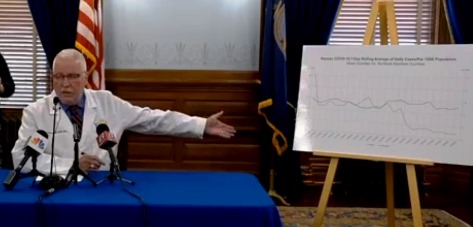
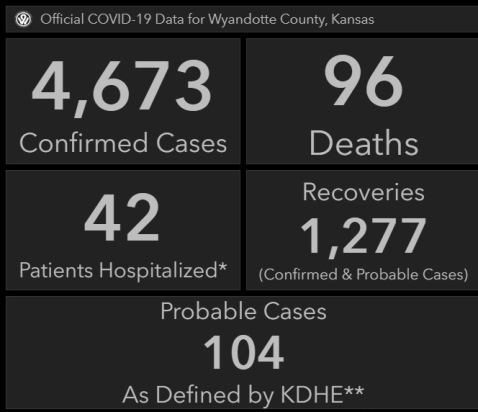
Dr. Lee Norman, Kansas secretary of health, showed a chart about mask usage on Wednesday that showed counties with mask mandates had COVID-19 rates that were declining, while counties without mask mandates were flat. (From KDHE news conference)Wyandotte County reported 4,673 cumulative positive COVID-19 cases at 1:15 p.m. Wednesday, an increase of 73 since Tuesday, according to the Unified Government COVID-19 webpage. There were no new deaths; the cumulative total remained at 96. (From UG COVID-19 website)
Masks work to prevent the spread of COVID-19, according to Dr. Lee Norman, and the “natural experiment” in Kansas shows it.
Dr. Norman, Kansas secretary of health, showed a chart during a Wednesday afternoon news conference. The chart had two lines, one for counties with mandatory mask orders and one for counties without them.
Although it wasn’t planned to be a scientific experiment or a trial, results from non-mask counties (the control group) were compared to results from counties with mandatory mask orders (the experimental counties). The results showed that masks work, Dr. Norman said.
There are 15 counties with mask mandates, including Wyandotte County, and about 90 Kansas counties without them, he said. The 15 counties account for two-thirds of the population in the state, and are mostly urban areas where people may come into contact with others more frequently.
Dr. Norman’s chart showed a significant decline in COVID-19 rates in counties with mask orders, he said, while counties without mask mandates had a flat rate. The governor’s mask order went into effect July 3; in Wyandotte County, masks have been mandated since June 30 by local health officials.
Dr. Norman’s chart covered July 12 through Aug. 3. It compared the number of cases per 100,000 in each county in the two groups, on a 7-day average. There is an improvement seen in counties where mask-wearing is mandatory, he said.
Since a vaccine is not available yet, masks are the only physical tools available at this moment to fight COVID-19, Dr. Norman said.
Dr. Norman said the Kansas Department of Health and Environment is sharing the stories of COVID-19 victims, with their permission, on a series of videos to help people learn more about the illness. Some patients were asymptomatic, and others had to be on a ventilator for a period of time, he said.
He said he has talked to some COVID-19 patients who had prolonged symptoms for months after having recovered from COVID.
The understanding of COVID-19 has been changing. For instance, it used to be an anomaly to find children who were hospitalized with it, he said. But now, it is more common, and there are child COVID-19 patients at Children’s Mercy Hospital frequently, according to Dr. Norman.
One student, aged 19, from Dodge City, had very mild COVID-19 symptoms in May, but this past weekend, he was bedridden with severe headache and fatigue, he said. He has had those symptoms since being hospitalized in May.
Another patient, aged 42, an athlete, is 125 days out from being diagnosed with COVID-19, and is still experiencing burning in the lungs and shortness of breath, he said.
It is humbling that they know so little about this disease, Dr. Norman said. They are still learning.
“I know wearing a mask is not the most comfortable thing to do,” Dr. Norman said. However, they’re getting a lot of aggregated data solidifying the belief that masks work, he said.
They are learning about the biology of the disease, and he said it is becoming clear that they should do everything possible to push the curve of the disease down as much as possible especially before the start of the school year.
Dr. Dana Hawkinson, medical director of infection prevention and control at the University of Kansas Health System, said it will take effort from everyone to get the state’s positive test rate of 9 percent down before schools can reopen and before a vaccine is available.
At the news conference on Wednesday morning at the University of Kansas Health System, doctors warning against vaping, and there are some reasons to believe that some who vapes may be more susceptible to COVID-19.
Dr. Matthias Salathe, chair of internal medicine at KU Medical Center and pulmonologist at KU Health System, said vaping can be just as dangerous as smoking. Some of the vaping patients now in the hospital have lungs that look like COVID-19 damage but are a different illness, according to Dr. Salathe. Vaping can cause lung injury, he said.
Dr. Amanda Olinger, director of pediatric services at KU Health System Marillac Campus, said adults vape and smoke on personal and private levels, in general, while for adolescents, it is a highly social event. They get together to smoke or vape with friends.
In the past, she’s seen infections transfer from one to another through vaping, she said. Last fall some mononucleosis cases were linked back to vaping and sharing, according to Dr. Olinger.
With teens in close proximity, not wearing a mask, and passing a vaping tube from one to another, breathing through it, that increases the risk of infection, according to Dr. Olinger.
It’s hard to get through to teens if they can’t see immediate harmful effects, she said.
Dr. Salathe was very optimistic a vaccine for the virus will be available by the first of the year. Because of the fast-tracking process, future vaccines will be available much quicker, he believes.
Dr. Hawkinson said there were 26 COVID-19 patients at KU Health System on Wednesday, down one from Tuesday. Five were in the intensive care unit, one less than Tuesday, and three were on ventilators, two less from Tuesday. The hospital peaked at 36 patients last week.
On Wednesday morning, Kansas had 29,717 cumulative positive COVID-19 cases, an increase of 841 since Monday, Dr. Norman said. The state had a cumulative 368 deaths, an increase of three since Monday.
Wyandotte County reported 4,673 cumulative positive COVID-19 cases at 1:15 p.m. Wednesday, an increase of 73 since Tuesday, according to the Unified Government COVID-19 webpage. There were no new deaths; the cumulative total remained at 96.
Free testing offered
Free COVID-19 testing is planned from 10 a.m. to 1 p.m. Thursday, Aug. 6, at the Holy Name of Jesus Catholic Church, 16 S. Iowa St., Kansas City, Kansas.
Free testing also is offered from 5 to 7 p.m. Thursday, Aug. 6, at the Vibrant Health Argentine location, 1428 S. 32nd St., Kansas City, Kansas.
The pop-up tests are offered through Swope and Vibrant Health and the Health Equity Task Force.
Free testing also is offered from 9 a.m. to 3 p.m. Monday through Friday at the Unified Government Health Department parking lot at 6th and Ann, Kansas City, Kansas. For more information, call 311.
Wyandotte County is under a mandatory mask order and is in Phase 3 of the state’s reopening plan. For more information, residents may visit the UG COVID-19 website athttps://alpha.wycokck.org/Coronavirus-COVID-19-Informationor call 311 for more information.
COVID-19 cases increased by 108 on Tuesday in Wyandotte County, according to the Unified Government COVID-19 webpage. There was one additional death. (From UG COVID-19 webpage)
As COVID-19 cases continue to increase in Kansas, there has also been an increase in violence, according to a trauma injury prevention education specialist at the University of Kansas Health System.
Olivia Desmarais, RN, former trauma nurse and now a trauma prevention education specialist, at a Tuesday news conference discussed violence against those who are 12 to 24 years old. Violence has increased in that group, and some believe it is tied to COVID-19 and increased stresses in society.
Desmarais discussed the Reducing Effects of Violence through Intervention and Victim Empowerment (REVIVE) program, which helps connect victims of violence with community programs.
Damon Daniel, president of the Ad Hoc Group Against Crime, said that violence is the leading cause of death among 10 to 14 year olds. The Ad Hoc group is one of several programs working with the REVIVE program to help change violence.
Daniel said violence is a learned behavior and people should strive for change while practicing forgiveness.
Dr. Jomella Watson-Thompson said lack of employment and economic insecurity is one reason behind the increase in violence during the pandemic. She said it is a community-wide problem, and she was grateful that this program can help bring resources together. She discussed ways the community can help.
Also speaking at the news conference was Kansas Department of Health and Environment Secretary Lee Norman. Dr. Norman said the KDHE has a new video feature, “Faces of COVID,” which includes first-hand accounts from Kansas residents who have dealt with the virus.
One video featured a 42-year-old mother of four, Amy Carrillo, from Lawrence, who was diagnosed with COVID-19 in March. While she didn’t think much about it at first, later her symptoms worsened. She experienced severe chest pain, and was in bed for a month. The symptoms lasted four months, and only in the past few weeks, her lungs stopped hurting.
Dr. Norman said the state is seeing 360 new cases a day, and he hoped that by sharing their own personal stories, the COVID-19 patients will reach people and help lower the number of new cases with Labor Day and school reopening approaching.
Dr. Norman said he anticipated an increase in cases around Labor Day, when people traditionally get together, and some could let their guards down.
He also expected to see higher numbers when schools are in session and the weather gets colder. Currently the state is seeing higher numbers of positive cases, and at the same time, the overall 14-day trend line is better, the hospitalization rate is better and the death rate is better. He said on balance, people are taking the masks more seriously. Overall, it’s improving with some problem areas, he added.
Since governments are not giving mandatory orders at the federal and state levels on COVID-19, Dr. Norman said people need to take the responsibility individually, and all need to “own our own preparedness.”
COVID-19 cases increased by 108 on Tuesday in Wyandotte County, according to the Unified Government COVID-19 webpage. There was one more death from Monday.
KU Health System reported 27 patients in the hospital for COVID-19, down from 30 on Monday, according to Dr. Dana Hawkinson, medical director of infection control and prevention at KU Health System. Six of the patients were in the intensive care unit, with five on ventilators, the same as Monday. After peaking at 36 patients last week, doctors hope the trend continues to decline as Labor Day approaches, with reopening of schools.
Free testing offered
Free COVID-19 testing is planned from 8 a.m. to 11 a.m. Wednesday, Aug. 5, at Zotung Christian Church, 5010 Parallel Parkway, Kansas City, Kansas. The pop-up test is offered through Vibrant Health and the Health Equity Task Force.
Free testing also is offered from 9 a.m. to 3 p.m. Monday through Friday at the Unified Government Health Department parking lot at 6th and Ann, Kansas City, Kansas.
Wyandotte County is under a mandatory mask order and is in Phase 3 of the state’s reopening plan. For more information, residents may visit the UG COVID-19 website athttps://alpha.wycokck.org/Coronavirus-COVID-19-Informationor call 311 for more information.