
Mayoral candidates differ on issues at forum

Tyrone Garner
David Alvey

by Mary Rupert

With about a week to go until Election Day, Nov. 2, mayoral candidates Tyrone Garner and David Alvey are hitting the campaign trail and attending forums, encouraging voter turnout.

Garner won the primary by a close 60 votes over incumbent Mayor David Alvey. The two candidates offer different approaches to the challenges of Kansas City, Kansas, and Wyandotte County.

At an online candidate forum sponsored by Business West and KCKCC on Wednesday, Oct. 20, issues including property taxes, police department and community relationships, and development of the northeast area were discussed.

Mayor Alvey, a former educator, said at the forum that he has been focused on neighborhood improvement infill housing as a strategy for economic development. It is a way to redevelop areas that have experienced disinvestment over the years, he added. With infill housing, vacant houses or empty lots where houses once stood are redeveloped in existing neighborhoods.

“I’m very proud of what our community did during COVID,” Alvey said. Although there was opposition to some of the measures, he believes they have done what they could do to prevent the spread of COVID. Alvey has made a number of videos on his campaign issues, available online at www.alveyformayor.com/.

Garner, former KCK deputy chief of police, said, “I’m running because I was asked by people in Wyandotte County.” People cited politics as usual, broken promises, and no development in disinvested areas, he said.

He said he could find real solutions to problems in the community. He believes in strong relationships and collaboration to get things done, he added. His platform, online at www.garnerformayor.com/, is from the concerns of people in the community, he said.

He said he was for streamlining government, equitable development, investing in disinvested areas, public safety reforms and enhancements, infrastructure improvements and a strategic COVID-19 recovery plan.

Candidates’ positions on taxes and PILOT fees

Alvey said traditionally high property taxes have been reduced a total of 6 mills over recent years, and Kansas City, Kansas, has gone from being the highest property tax in Kansas first-class cities to 15th out of 25, which is an improvement.

The economic downturn in 2008 resulted in an increase in the PILOT fee, found on Board of Public Utilities bills, because the Unified Government already did furloughs and layoffs, cut services and did not want to make more cuts, Alvey said. The UG then turned to an increase in the PILOT fee to provide basic services.

“The strategy has got to be more economic development,” he said.

More development is needed throughout the community, including the east side, he said, mentioned new businesses on 5th and 6th Street, a new Menards on I-35 and the Rock Island bridge development.

“The long-term strategy has got to be to continue to grow the tax base,” he said.

Garner said there were four years of promises that have not been kept in this area.

The adverse effects that property taxes and BPU bills have on seniors and hard-working families that are trying to make ends meet are heartbreaking, he said.

“We can do a better job lowering the BPU PILOT,” Garner said. “My proposal is to lower it 2 percent every year for the first four years, and take it off the BPU bill, so the BPU bill can be a more reflective and adequate utility bill.”

This year, property values have increased, with millions more coming in from property taxes, not including extra federal ARPA funds that came into the UG, Garner said. The mill levy was left the same as last year. The opportunity to lower property taxes was there, and it was not done, he said. He said it was a failure of leadership.

“We’ve given tax abatements to huge corporations that paid zero property taxes and have gotten huge infrastructure giveaways on the back of hard-working taxpayers and our kids who go to school,” Garner said. He agreed the tax base needs to be broadened and bring in business, but they need to have responsible incentives and developments, where everyone can share and broaden the tax base responsibly.

Economic segregation continues to occur in disinvested areas of Wyandotte County, Garner said.

On the investigation into KCK police

On the topic of police investigations, Garner cited his five years of work in the internal affairs department of the KCK Police Department as a young officer.

“I didn’t give accused officers a pass,” he said. A lot of officers were disciplined as a result of his work, he added.

He said he stood firm with District Attorney Mark Dupree’s call for a conviction integrity unit, and Garner also supported the 21st century policing initiative, against a culture that fought against it. He said he had total confidence in Police Chief Karl Oakman, and believes he will bring in reforms.

There is mistrust of police in communities of color, and there’s a lot of work to be done, Garner said. There are a lot of good police officers, and there is a need to get the 1 percent of bad officers out of there, he said. He said he would support the chief, the DA and the sheriff if elected.

Alvey said it is important to continue to build trust between the police and the community. If people have a bad experience with one part of the criminal justice system, it carries over to other parts of it, he added.

He cited his task force on police and community relations, which took an in-depth look at police and criminal justice system policies and procedures. Most of the recommendations of 21st century policing were already implemented here, he said. Seven out of eight demands from an advocacy group had already been implemented, and the eighth one was implemented this past year, Alvey said.

They need to continue to work on diversity on the police force, Alvey said, and Chief Oakman has added a Hispanic liaison officer to help the community feel comfortable about coming to the police about problems.

“This is a continuing thing,” Alvey said about the task force. The next task force topic will be restorative justice, with the goal of healing the criminal and the victim, he said.

Investing in the northeast area

Alvey said the problem with redlining and disinvestment was that property values were declining. If a property was bought for $100,000, and the property value declined, it would be hard to get a loan to do repairs, he said. Blight followed as they couldn’t borrow the money to make the repairs, he said.

Long-term, they have to focus on people who have “weathered the storm,” including those on fixed incomes and elderly, Alvey said. There is a proposal in the state Legislature that would provide relief to those on fixed incomes affected by rising property values, he added.

With market demand driving up the values of homes, that’s a good thing, he said. But relief is needed for people whose tax bills are going up and are having a difficult time, he added.

They need to make sure the strategies they put in place activate the Northeast Master Plan, he said. The market needs to come in, he said, and developers need to know their investments will pay off.

The process has to be community development, not just dollars, he said. He cited Argentine as an example of people who fixed up their homes and raised property values.

Garner said the concept is good, but it is failing because there isn’t a comprehensive strategy. There should be a strategic plan and not haphazard fill-in housing, he said. He would like to see all income levels addressed for housing. He said he would like to see an expansion of the Neighborhood Revitalization Act, for tax abatements on houses east of I-635.

Developers have told him the problem is bureaucracy, and problems in communicating with staff, Garner said. It takes too long to get something done in Wyandotte County, he said. Developers would like to streamline it, he added.

When it comes to the mayor’s promises, nothing has been realized to the satisfaction of the residents of the northeast area, Garner said.

“People should not have to beg for a grocery store,” Garner said. “They should have swings that work. They should not have a pool that is closed.”

Putting the Parkwood swimming pool in the hands of private management who cannot guarantee the pool will be open is irresponsible, Garner said.

He said the community needs someone who will hold staff accountable to the will of the elected commission and to the values of the people.

“We could do better for Wyandotte County, we could do better for our neighborhoods, and we could do better for our community,” Garner said.

Alvey said through his entire time as mayor, they have taken an honest, straightforward look at every challenge that has confronted them. They have not been able to achieve all the things they would like to achieve, since it is a long-term process, he said. There has been 60 years of disinvestment, and the northeast is coming back and growing, he said.

Alvey said Garner’s plan to reduce the PILOT fee, which will reduce income to the UG by $32 million, was unrealistic.

“You cannot invest in neighborhoods, streets and parks, stormwater and all those services that he says we need to have more of, and reduce by $32 million the amount of revenue our Unified Government has,” Alvey said. He said the UG is developing a strategy, and it will continue to grow the county.

Negative flier went out before election

Much has been made of the candidates’ differences, but there are also similarities. Both candidates are from Wyandotte County. When filing, both listed addresses on the south side of the county, Alvey in the Turner area and Garner in the Rosedale area. Both are Democrats and both had prior experience on local elected boards, Alvey with the BPU and Garner with the KCKCC Board of Trustees. Both have expressed their belief in God publicly. Both had decades of experience at one employer before seeking political office, Garner with the KCK Police Department and Alvey at Rockhurst High School.

Garner, a former deputy police chief in Kansas City, Kansas, has received union support from the local firefighters, police and some other area unions. The firefighters union had supported Alvey when he ran against former Mayor Mark Holland, but the union has since differed with Alvey over issues such as closing the Fairfax fire station and ongoing contract negotiations.

During the Oct. 20 forum, Alvey did not repeat his statement from an Aug. 31 forum when he asked Garner for an explanation of being on the police force at the time of alleged police corruption involving a retired detective. Garner had denied knowledge of the alleged corruption, while also stating he has worked to get corrupt officers off the force. (See previous story at https://wyandotteonline.com/mayoral-candidates-spar-on-question-of-police-department-investigation/)

When a national story broke Oct. 14 about a grand jury investigation already underway into the actions of a retired Kansas City, Kansas, police detective, the candidates offered statements at https://wyandotteonline.com/allegations-against-former-kck-police-detective-getting-national-attention-from-cnn/.

As the election gets closer, the Alvey campaign appears to have gone negative in a mailer, a sign that the campaign could be behind where it wants to be. A negative flier listed as from the Alvey for Mayor campaign went out within the past two weeks to Wyandotte County voters, criticizing Garner for moving to Johnson County after he retired from the police department here. He since has moved back to Wyandotte County, after being asked by residents to run for office, according to the Garner campaign website.

The recent flier also echoed some of the earlier statements from the Aug. 31 forum, stating that Garner “either failed to address allegations of abuse and corruption or he refused to speak up until it was politically convenient.” Garner said at the Oct. 20 forum that he didn’t give any accused officers a pass while he was on the police force, and that a lot of officers were disciplined as a result of his work in the internal affairs unit.

The KCKCC and Business West Oct. 20 forum is expected to be shown on the KCKCC cable television station and on YouTube.

Another mayoral campaign debate is scheduled at 4:30 p.m. Wednesday, Oct. 27, at Memorial Hall in Kansas City, Kansas. The campaign forum is sponsored by the Kansas City, Kansas, Area Chamber of Commerce, and reservations are required to https://mailchi.mp/kckchamber/alveygarnerdebate?fbclid=IwAR0WyhYODQjlCxG3Gy8OccZAFTi8bee4OO0e_tSeR0EI9a13jZ84zxm5XhM. The event will be both in person and online.

For more information about the election, visit https://wyandotteonline.com/category/election-2021/.

For information about advance voting and polling places, visit www.wycovotes.org.
UG Commission on Tuesday to consider halting delinquent tax sales until spring

by Mary Rupert

The Unified Government Commission, at a special meeting called for Tuesday, is scheduled to consider halting delinquent tax sales until the spring.

A special UG Commission meeting was called for 5 p.m. Tuesday, Oct. 26. According to the agenda, the Oct. 28 and Jan. 13 tax sales will be considered for postponement. They would be rescheduled for Thursday, April 28, under a proposal.

According to the proposed resolution, the UG has concerns regarding the potential displacement of persons who may lose their homes in the tax sales, and the proposed resolution would give them more time to find a resolution to paying the taxes.

Several UG commissioners have been working on the homeless situation and possible solutions.

The UG Administration and Human Services Committee on Monday night heard about plans to address homelessness and to help the needy in the community, including a plan to apply $293,000 in unused Emergency Services Grant funding for a temporary shelter for cold weather emergencies, open when the temperature dips below 28 degrees.

“I’m so grateful for the forward progressive thought, instead of scrambling for a shelter, we’re planning for a shelter,” Commissioner Melissa Bynum said at the Oct. 25 meeting.

The UG Administration and Human Services Committee also heard about a $3.2 million federal Housing and Urban Development grant to the UG for housing services and shelter for those experiencing homelessness and other vulnerable populations. The grant is through federal American Rescue Plan funding.

Also, the Administration and Human Services Committee on Monday night gave preliminary approval to an additional $44,285 to Mt. Carmel Redevelopment Corp. to be used for the Willa Gill Center, which provides food and services to the needy. The center has experienced increasing costs recently. The funding will go toward additional funds for personnel and facility equipment.

‘Furious’ about tax sale

The upcoming tax sale this week has been the topic of considerable controversy in the community.

“I am furious,” State Sen. David Haley, D-4th Dist., said last week about the upcoming tax sale.

“No other county in the state of Kansas has had a delinquent tax sale online,” Sen. Haley said. The tax sale had been scheduled online only, not on the courthouse steps, and not at Memorial Hall as in previous years, because of COVID.

Last week, he said the UG was stealing property from marginalized people to give to developers through the Land Bank. He said he doesn’t mind developers working on their projects, what he minds is a theft from marginalized families that worked hard to obtain that land and should have something for the later generations of their family. The families do not receive any money for the property they lose, he added, not even 25 percent of its value.

He believes the delinquent tax policies are discriminatory toward the poor and communities of color, as they have affected these groups more than other groups.

“We’ve identified 11 people living in the houses so far that will be put out of their homes,” Sen. Haley said last week. “It’s absolutely immoral.”

People may owe anywhere from hundreds of dollars up to $30,000 in delinquent taxes, he said.

Although the amounts they owe are often too large for other people to help them with, nevertheless an effort has been made in the past months to raise funds for people in danger of losing their homes at the tax sale, Sen. Haley said last week.

WyCo Mutual Aid and Groundwork Northeast Revitalization group have been “crowdfunding” for residents who are at risk of losing their homes in the tax sale, Sen. Haley said. For more information on how to contribute, see https://www.facebook.com/wycomutualaid.

Sen. Haley said the question has been posed to the Kansas attorney general and the Missouri attorney general as to whether this tax sale could be held online only or not. Kansas said yes and Missouri said no, he added.

The Kansas attorney general’s Oct. 4 opinion stated that foreclosure sales have to be public auctions under state law. However, according to the opinion, the “requirement for public auction is satisfied by use of an online auction site with members of the public being allowed an in-person place in the county to observe or bid. Kansas law does not specifically require a public auction be held solely in person.” (See the AG opinion at https://ag.ks.gov/docs/default-source/ag-opinions/2021/2021-003.pdf?sfvrsn=71e4a51a_6)

Sen. Haley argues that some of the people who are affected by the tax sale are not computer-savvy, even though the UG offers them the chance to use a computer at a public location.

Sen. Haley also said he is considering introducing legislation about requiring tax sales to be in person at the next legislative session.

“There’s a movement online to try to raise enough to pay off the tax bills of these 11 people who are losing their family home,” Sen. Haley said. He added he donated $500 to the effort.

Wyandotte County residents urged to support effort to keep Johnson, Wyandotte counties in 3rd District

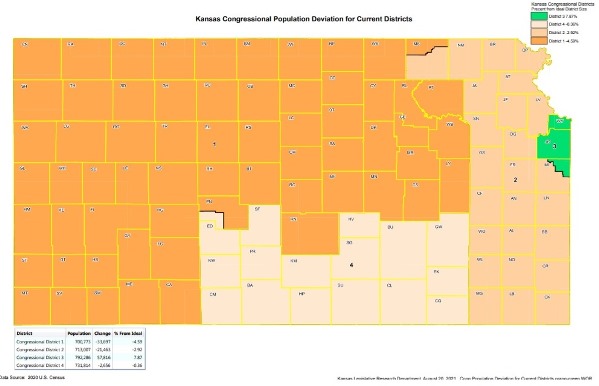
A map from the Kansas Legislative Research Department showed the Congressional districts in Kansas. The 3rd District, in green, is the only one that showed growth, and it is 57,816 people over the ideal population. Next to the 3rd District is the 2nd District. (Map from Kansas Legislative Research Department)

by Mary Rupert

Wyandotte County residents were urged to send letters supporting keeping Wyandotte and Johnson counties together as much as possible in the 3rd Congressional District.

The Unified Government Commission, at its Oct. 14 meeting, voted to send a letter of support to keep the counties together in the 3rd District. They also encouraged residents to send in letters.

The Kansas Legislature currently is drawing new lines for the state’s four Congressional districts and its state Senate and state House districts. It is using new population data from the U.S. Census results that came out this summer.

Because population increased in both Johnson and Wyandotte counties, the 3rd District most likely will be trimmed somewhat. The district also includes a small part of Miami County.

The political concerns are that some lawmakers in a Republican-controlled Legislature may attempt to create a district where U.S. Rep. Sharice Davids, a Democrat, cannot win re-election. Some observers fear that an attempt to split the 3rd District will be made, with possibly an attempt to put some of Wyandotte County in with the 1st District of western Kansas. One year ago, the former state Senate president suggested that they redraw the district maps to make sure Republicans win the 3rd District. (See https://kansasreflector.com/2020/10/09/senate-president-susan-wagle-embraces-gerrymandering-to-benefit-gop-in-kansas/)

Legislative hearings have already been held for the public to make comments; however, written testimony is still being accepted, and there is still time for the public to send letters to the committee. The oral testimony at a hearing at KCKCC Aug. 12 was all in favor of keeping Wyandotte and Johnson counties together. The new population figures were not in yet at the time of the hearing.

Recently, the population figures were released, including down to the precinct level, Commissioner Tom Burroughs said at the UG Commission meeting Thursday.

The maps show a lot of growth in the Piper area of Wyandotte County, affecting the 36th state House district and the 5th state Senate district. Some other areas of Wyandotte County also had growth.

Burroughs is also a state representative who serves as the ranking House minority member of the redistricting committee.

He said the 3rd Congressional District will be quite challenged to remain whole, with an influx of population in the two counties. There was a tremendous growth in Johnson County, he said. Johnson County will probably pick up two new state House seats and possibly a state Senate seat, he said.

The state legislative redistricting website showed a 12.07 percent increase (over 65,000 increase) in Johnson County’s population, and a 7.45 percent increase (11,740 increase) in Wyandotte County’s population.

The 3rd Congressional District increased 57,816 in population to 792,286, while the 1st District decreased 33,697 and the 2nd District decreased 21,463. The 4th District declined 2,656. The ideal population for each district is 734,470. (See http://www.kslegresearch.org/KLRD-web/Publications/Redistricting/Kansas-Population-Change-2010-2020-by-Congressional-District.pdf.)

Burroughs said people in the 1st Congressional District also wanted to see the 3rd District remain whole and not transfer part of it to join in a district with western Kansas.

“We share a border with the metropolitan area,” he said. “We have urban communities that are not related to the rural communities; our industries are different,” he added.

He urged people to submit letters to the committee, remembering that everything is subpoenaeable.

Other written testimony on file with the committee stated that Wyandotte and Johnson counties share common concerns, are members of the Mid-America Regional Council, and work on metropolitan area projects jointly.

Burroughs said redistricting maps will be in bill form, with any change requiring another bill. Each chamber will have its own maps, and will work toward an agreement. Then, when they agree, the final bill will go to the governor for a signature. If she vetoes the bill, it will go back to the Legislature to start over again, Burroughs said.

Commissioner Christian Ramirez asked everyone to focus on the data, not on the politics, and to do what’s fair.

Redistricting and Wyandotte County districts

State Rep. Valdenia Winn, D-34th Dist., said Rep. Burroughs’ 33rd district and Rep. Kathy Wolfe Moore’s 36th district, along with her district, grew in population. The 33rd District and the 36th District were 3,000 to 4,000 over the ideal population, she said.

“As long as we can shift some precincts within the county on the House side, I think we’re good,” Rep. Winn said on Tuesday.

However, Rep. Winn was not so sure about the state Senate districts. Sen. Jeff Pittman, D-5th Dist., has a district that includes a large part of Leavenworth County, and Sen. Pat Pettey, D-6th Dist., has a district that includes parts of Johnson County.

“If we had our way, it wouldn’t have any impact,” Rep. Winn said.

“Yet the larger question is whether we stay in the 3rd (Congressional) District with Johnson County,” Rep. Winn said.

There has been talk occasionally about putting Wyandotte County in the 1st District with Garden City and western Kansas.

“How bizarre for Wyandotte County to be in the same district as Garden City,” Rep. Winn said.

She recalled the story about the former state Senate president who was captured on video at an event last year saying that they can redraw the districts so that Republicans would win.

“They have the power,” Rep. Winn said.

Ten years ago, the redistricting map went to the courts, she said, and the same thing could happen again this time.

State Rep. Pam Curtis, D-32nd Dist., said her district would have to grow, estimated by about two precincts. It might be possible that a couple of precincts from Rep. Winn’s district could be added to Rep. Curtis’s district. Another district that needs to add some population is Rep. Louis Ruiz’s 31st District, she said.

At this time, it appears that Wyandotte County won’t lose any state House districts, she added.

Local legislators are thinking it might be a good idea to advocate for retaining districts within the county and not splitting them, she said.

She said they still don’t have the final population numbers for the districts, and once they get them, they can hone in more. A change this year is that there are computer programs that can do redistricting mapping, she added.

Population increases seen in two state Senate districts

State Sen. David Haley, D-4th Dist., was on the redistricting committee from the 2010 and 2000 census counts, although not on the current committee.

“I’m very interested and remain interested in the process of reapportionment of districts and the geographical lines,” Sen. Haley said on Tuesday.

It’s a bit surprising that politics and political partisanship are still allowed to determine the various outcomes, he said.

Sen. Haley said he didn’t think the 1st Congressional District as it is currently composed is a match to make a “community of interest” with Wyandotte County, as would be required by the rules governing redistricting. He said he hopes it would not meet court muster if they try to do that.

He said the state Senate’s 4th District and 5th District both came in with a population increase, and both will need to lose some of their population to maintain the statistical average. He did not think his district would change very much, though.

Sen. Haley said he believes it would be difficult for conservative legislators to justify sharing or changing the existing lines of the 5th state Senate District, where Sen. Pittman, from Leavenworth, currently holds office.

One of the questions that often comes up is will Wyandotte County continue with three state senators, or will it have two? Would the lines be drawn for two state Senate districts, with about 20,000 of the population left over and going to an adjoining district?

“The problem is that Sen. Pettey’s district, the 6th, is shy of population,” he said. It needs to increase by 5,000 or so constituents, he said, and the 4th District needs to lose about that many residents. If the 6th district would move entirely into Wyandotte County, it would have to pick up more residents than that, according to Sen. Haley.

Sen. Haley said that while he imagines there might be all sorts of maps under consideration, he hasn’t seen any made public yet. He hasn’t even seen them privately, he added.

“This is going to go quickly,” Sen. Haley said. The filing deadline for state representatives and congressional races is going to be the first week of June 2022, about eight months from now, he said.

“That’s not a long period of time for people to acquaint themselves with their district to be a state representative or senator,” he said.

Sen. Haley said he was most surprised by his district, for the first time, increasing in population.

“The assault on real property ownership by the local government, UG, in the aggressive taking of private lands through covert real property tax sales, delinquent property tax sales, misled me to believe that there would be a resulting loss in population in the district,” Sen. Haley said. “So I was surprised that this statistical anomaly of an increase was actually proven by the census.”

“I believe the 2030 census will result in a population boom east of I-635 all the way down to the Johnson County line in Wyandotte County, of even greater population still,” Sen. Haley said.

Where to send redistricting letters

Written testimony or letters may be submitted at any time to the legislative redistricting committee before the 2022 legislative session begins. For more information and details on how to send the testimony, visit http://www.kslegresearch.org/KLRD-web/Committees/House-Senate-Redistricting-Committees-2021.html or call 785-296-3181.

For more information, see http://www.kslegresearch.org/KLRD-web/Redistricting.html.