by Mary Rupert
The Fairfax industrial district of Kansas City, Kansas, is celebrating its 100th anniversary this year with several events.
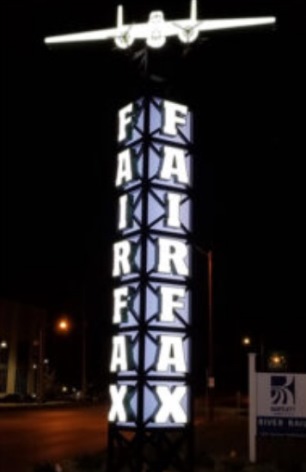
Thursday afternoon, June 9, a ribbon-cutting is scheduled at the tower that marks an entranceway to the Fairfax area, near 7th and Funston, said Melissa Clark, executive director of the Fairfax Industrial Association.
Fairfax, according to Clark, when it started was the main place to fly in and out of the area. It is believed to be the first planned industrial district in the nation, according to information from the FIA.
The late President Harry Truman used to fly in and out of the Fairfax airport, Clark said. The Fairfax district made B-25 bombers as well as landing craft during World War II.
Besides today’s ribbon-cutting at the Fairfax towers, the Fairfax Industrial Association is planning other events to commemorate the 100th anniversary.
An exhibit about the history of the Fairfax area will open July 5 at the Wyandotte County Museum, running through Sept. 24, she said.
Then, a “mini museum” exhibit will be displayed Oct. 6 at the annual Fairfax Festival, to be a finale of the 100th anniversary celebration, at Kaw Point Park, Clark said. This will be the main celebration event for the 100th anniversary, Clark said.
Other events that are scheduled include a Fairfax Night at the Monarchs on July 28, when video clips of Fairfax will be played on the stadium’s big screen; an FIA luncheon with Esther George, president of the Kansas City Federal Reserve, at the Truman Library on Aug. 18; and an FIA luncheon on Sept. 15 at the Wyandotte County Museum, where the Fairfax exhibit will be on display.
Through the years, the Fairfax district has grown into a powerhouse of manufacturing. The district has about 135 businesses and has more than $5.4 billion in annual sales, Clark said. More than 10,000 people are employed there.
“We store all the metro’s fuel and the jet fuel,” Clark said, with 95 percent of the gasoline and diesel fuel in the Kansas City area and 100 percent of the jet fuel stored with three pipeline companies located there.
“The CertainTeed plant is the largest insulation plant in the world,” she said. “Seventy-five percent of all Cheez-Its are made at Kellogg’s in Fairfax.”
History of Fairfax district to be detailed in museum exhibit
A new exhibit on the history of the Fairfax district will open July 5 at the Wyandotte County Museum, located in Wyandotte County Park, Bonner Springs, near 126th and State Avenue.
Amy Loch, executive director of the museum, said there will be personal stories from employees who worked there, along with items collected that tell the story of the district.
The exhibit will have company uniforms, identification badges, hard hats, tools, even the Hydrox cookie recipe, Loch said. The Hydrox cookie was developed at the Sunshine Biscuit Company in the Fairfax area, and that plant is now Kellogg’s. Loch added the recipe will not be too valuable for home use, as it contains large industrial quantities.
“There are mortar shells brought in from the B-25 plant,” Loch said. “There’s also a cookie press, cracker press from Keebler, and a special tool to make the cookie shape.”
While the deadline for sending items to the museum for display has passed, if people still have Fairfax stories or objects they think could be part of the exhibit, they are encouraged to send them in right away, according to Loch.
Before its development, the Fairfax area was largely an agricultural area along the Missouri River. It was known as mostly swampy farmland before development, according to Loch.
Guy Stanley, an early promoter of the Fairfax district, became a champion for the district, she said. He represented landowners, who worked with the Woods Brothers and later the Union Pacific to develop the Fairfax area. The Woods Brothers, out of Nebraska, was one of the first companies to invest in the area and was instrumental in installing a dike system, she said. While the Missouri Pacific was there first, the Union Pacific was a major railroad that invested heavily in the Fairfax area, she added, putting in $3 million to purchase land, establish roads and tracks and funding the early vision of Guy Stanley.
The Fairfax district had a number of early flying schools in the early 1920s, and the municipal airport opened there in 1929, Loch said. Airplane manufacturers were some of the first industries in the area.
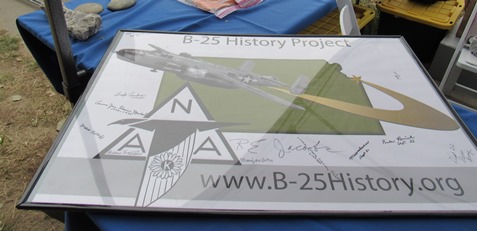
The Fairfax district started to develop as an industrial and aviation base prior to World War II, she said. Pre-war, the North American Aviation plant was constructed there to manufacture B-25 airplanes. After World War II industries left, the infrastructure was set up and it really boomed after that point, Loch said. The bomber plant was converted into automobile manufacturing, and a new auto plant was constructed in the 1980s.
Through the years the Fairfax district has had aviation-related businesses, such as Trans World Airlines. The Fairfax municipal airport, however, was closed in 1985.
Loch said she had seen different stories about how the Fairfax district was named. She said most people think it was named by Guy Stanley after Fairfax, Virginia, an area he liked, although historians are not completely sure about the name’s origin.
In a 1985 article, the late local historian Margaret Landis wrote that the history of the Fairfax airfield went back to 1921 when it was said to have been used for an American Legion air meet. E.J. Sweeny constructed a single-hangar workshop for six planes and started a flying school there, and his field was known as the Sweeny Airport in 1925, according to the article. The field was taken over by Woods Brothers in 1928, and named Fairfax.
According to Landis’ article, Kansas City, Kansas, purchased the Fairfax Airport for $600,000 in 1941 from Kansas City Industrial Land Co., a subsidiary of Union Pacific. It was then leased to the federal government, as part of the efforts for the North American bomber plant project.
The Fairfax district was annexed into Kansas City, Kansas, and it has been a huge resource to the city and county over the years, according to Clark.
Future looks bright for Fairfax district
Recent supply-chain shortages in America have placed a renewed emphasis on relying more on domestic manufacturing.
Clark believes there’s a lot of good things ahead for the future of the Fairfax district.
“I think its future is bright,” she said. “It’s an old district, but it’s a great location, and there’s almost no vacancies in Fairfax.”
Some of the older buildings that are not used for manufacturing currently are used for other purposes, such as storage, she said. There may be future space available when redevelopment happens for some nearby areas, she said, such as the old Quindaro power plant owned by the Board of Public Utilities.
“Everyone is thriving, manufacturing is thriving, and I think it’s going to get better and better, after what we’ve gone through,” Clark said.
For more information on the Fairfax 100th anniversary celebration events, visit https://fiakck.org/.