
BPU makes minor change to cold weather rule

A slight change was made Monday to the BPU’s cold weather rule.

A freeze warning was in the forecast Monday night when the Board of Public Utilities passed a small change to its cold weather rule.

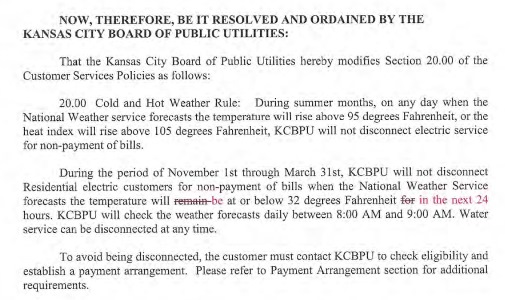
The cold weather rule states that electricity cannot be disconnected when the temperature is forecast to be at or less than 32 degrees in the next 24 hours.

The change unanimously passed on Monday night modified the wording from “remain at or below 32” to “be at or below 32 in the next 24 hours.” That could result in slightly fewer customers’ utilities being shut off.

There was little discussion at Monday night’s meeting around the change, but earlier, BPU board members had discussed it at committee meetings and work sessions for some months.

At the Oct. 5 BPU board meeting, board vice president Rose Mulvany Henry recalled that during a presentation June 22, BPU staff stated that 71 percent of the customers who were disconnected were reconnected the next day.

Even though the National Weather Service predicted a low of 25 tonight, the cold weather rule will not apply this week. It is only in effect from Nov. 1 to March 31, a provision of the policy that did not change.

With the coming of the cold weather, options are narrowing for customers who do not have the funds to pay their utility bills. A state assistance program, the Kansas Emergency Rental Assistance program (KERA), announced last week that its utility and rental assistance program was on hold, having spent its funding. “KERA has now received enough applications to exhaust all funds and has entered the Hold Phase,” a news release from the program stated. Any applications that come in now will not be reviewed or processed until enough funds become available, according to the news release. When all funds are exhausted, the program will close and will stop accepting new applications, according to the release.

The BPU board did not make other changes Monday that have been advocated by community activists recently.

According to the BPU’s customer service policies listed online, there is a $10 electric disconnection fee and a late payment charge of 5 percent of the outstanding bill. These are paid along with the outstanding balance.

Activists request action

Appearing at a Unified Government Commission meeting on Thursday, Oct. 13, Louise Lynch, a Kansas City, Kansas, resident, told the commission that the charter needed to be changed, and she also had discussed changes that she believes should be made at the BPU at a previous UG meeting. She also talked about a UG commissioner’s response to her and how she and her family felt afraid; for more information, see https://www.youtube.com/watch?v=gfSJcBh3rhg.

Lynch has advocated for the BPU to stop disconnecting customers who have medical equipment powered by electricity.

Ty Gorman, a Kansas City, Kansas, resident who has represented the Sierra Club, said at the Oct. 13 meeting that he and volunteers have been working the past couple of years to get BPU to stop disconnecting people who will be in medical danger from disconnections.

Gorman asked the UG Commission to help engage the community in a planning process, a measure similar to one that was passed in Kansas City, Missouri, in 2005. He said the community needs to receive access to federal grant funding that could allow the BPU to get the bills paid without having to threaten to cut people’s electricity off.

As the KERA program ends this month, it will become even more important, he said. While there are other community programs that help residents with utility expenses, the other programs often run out of money, according to Gorman.

The planning process also would allow the community to engage in a climate action plan or climate mitigation plan, he added.

BPU bills will look like they’re increasing

The BPU board also heard from general manager Bill Johnson that BPU bills will look like they’re increasing in the future, as the UG Commission recently approved rate increases for certain UG fees included on the bills, such as trash collection and stormwater.

BPU board member Bob Milan Sr. said that the BPU had nothing to do with the fee increases, but the BPU will be criticized by people who see their BPU bills increasing because of the UG rate hikes.
Rosedale area residents speak out about high-rise apartment proposal

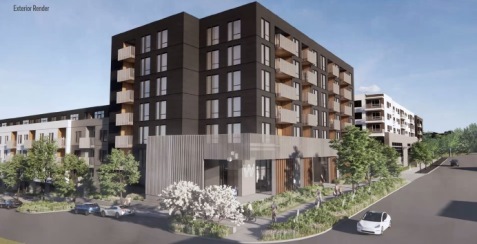
A developer’s picture of a high-rise apartment project proposed near 46th and Rainbow Boulevard.

Rosedale area residents turned out for zoning meetings on Monday night as the Woodside high-rise apartment project returned to the agenda after being sent back for more work.

Two homes near the apartment project, which is at 4601 Rainbow Blvd., would be in the shade for about two or three months out of the year, residents learned at the meeting.

One of the affected homes belongs to former state Sen. Chris Steineger.

Developers told the planning board that they had made extensive changes to the project after meeting with neighborhood residents.

Blair Tanner, the developer, who also owns Woodside Club, talked about changes they made to the plans, such as cutting some stories off the top of one side of the building to reduce the shade it will cast on the neighborhood. On one side, the building was reduced from seven to five stories. The shade will be reduced 15 to 19 percent from the original plans, he said. The original 172 units were reduced to 149 units.

The project has parking spaces available for those who live in the apartments, according to developers. The developers will use some of the right of way to add eight parking spaces next to the street.

At the Board of Zoning Appeals meeting on Monday night, Steineger said the concerns remain the same and that a smaller building still casts shade on property, including his home. His concerns were mainly traffic, and overall sizing, he added.

He was concerned that there would be traffic problems on 46th Street, especially with delivery truck drop-offs. There are hospital area employees and dental office employees who park in the parking lot that will be developed for the apartments, and he was concerned they would start parking along streets in the neighborhood. He suggested that 46th Street could be closed near the dental office, with traffic staying on Rainbow.

Shari Wilson, Steineger’s spouse, said her primary concern was the shadow study. “My home is directly affected by that – in almost complete shade every day for the entire winter. You might think about what that might be like.”

Former Mayor Carol Marinovich also spoke at the Board of Zoning Appeals meeting, in behalf of Gil Pintar of Hanover Heights. She said Hanover Heights was not against the development, but the project just needed to be tweaked more to meet the master plan.

Erin Stryka, president of the Rosedale Development Association, opposed the project, saying it failed to meet the goals of the master plan. She said she didn’t think the project would maintain the affordability of housing in the area. She did not believe it would be affordable for senior citizens or students, and she was concerned it would push up rents in other housing in the area. She would not like to see middle and low-income residents pushed out of the neighborhood they worked so hard to preserve, she said.

Greg Kindle, president of the Wyandotte Economic Development Council, said he supported the project and that it offered quality housing at one of the entrances to the community. It will offer housing for those in the health profession to remain in Wyandotte County and live in that area, he said. It includes landscaping, sidewalks and the design creates architectural interest, he added. The building wraps around a parking area for the apartment residents. The plan limits parking in the neighborhood while generating revenue and new investment in the community, he said.

Developers said while the project had a lot of opposition to begin with, it now has more support from neighbors after meetings and changes to the original plans.

The project received a go-ahead on a 6-2 vote from the City Planning Commission, and a variance on a rear yard setback was approved 9-0 by the Board of Zoning Appeals on Monday night.

The apartment project next goes back to the Unified Government Commission on Oct. 27 for approval.

The Board of Zoning Appeals meeting started at 6 p.m. Monday and was followed by the City Planning Commission meeting, which ended at 12:15 a.m.

‘Conscience of community’ speaks out

Window

Opinion column

by Mary Rupert

Every now and then, you can hear the “conscience of the community” speaking out at a public meeting in Kansas City, Kansas.

Louise Lynch is one of the residents who might currently be termed the “conscience of the community.”

Right before the Unified Government Commissioners voted on the budget Sept. 15, Lynch spoke out, letting them know how mixed up and just plain wrong the priorities are in local government.

She told them she was tired of seeing the back-and-forth in the local government, then nothing gets done.

“We need our commissioners to do the job for everyone and not just your area,” she said.

Lynch has appeared at the Board of Public Utilities meetings numerous times previously to urge them to stop disconnecting electricity for nonpayment of bills. She also advocated for additions to the BPU’s list of customers with medical equipment. People who are on the medical list can get cut off for nonpayment, she said. She first started speaking out when serious medical conditions affected her family’s ability to work.

She appeared at the UG meeting Sept. 15 to urge commissioners to take action to help BPU customers.

While there was a time when a moratorium was in place on shutting off electricity for nonpayment, the local utility now has returned to shutoffs for nonpayment. Lynch stated that currently, some customers who have assistance applications pending before the Kansas Emergency Rental Assistance program have had electricity cut off. The extra reconnection fees these residents are hit with could very well have been money that could have been used to help others, she pointed out.

Because of the efforts of Lynch and others including Ty Gorman, a community activist who has represented the Sierra Club, the BPU board decided to re-evaluate its shutoff policy. The board has not yet voted on it, but the latest version under discussion appeared to be somewhat similar to the old policy that was in place.

Gorman stated at the UG meeting Sept. 15 that there’s no reason to keep disconnecting electricity here, as federal legislation including the inflation reduction act and jobs act had a lot of funding available for utilities to repay costs and debt. Gorman urged the UG to get involved in this issue and make sure people are not being put in danger.

Later, after the meeting, Lynch questioned the UG Commission approving taking $105,000 out of the mayor’s-commission discretionary fund and moving it to a commission district line item, splitting the funds among each district, with individual commissioners deciding how to spend the funds.

She noted that Commissioner Andrew Davis, who made this motion, said at the meeting that the funds could be used for block parties in the districts. There wasn’t prior public discussion on this item.

“We don’t have transportation for the disabled and aged to go to medical appointments,” Lynch said. “We don’t have enough homeless shelters for the winter.”

Lynch said she has been told that eight of the commissioners will vote together and will not vote for anything the mayor wants.

“I am sick of watching meetings, constant fighting and nothing gets done,” Lynch said.

Lynch is correct. There is a split in the UG government. There’s also been a shuffle going on the past several years with the BPU saying it can’t do anything about the PILOT fee that the UG places on its bills, which is true. The UG, while holding some meetings, is not doing anything on these issues at budget time. In the meantime, nothing really changes. More shuffling happens when the UG Commission says it is not required by law to do an action. The BPU’s latest viewpoint is that they are running the utility like a business and can’t afford to forgo the extra disconnection fees they place on residents.

The commission and the mayor will need to work together, and with the BPU, to get some meaningful changes made that will end the cycle of victimizing lower-income residents with endless fees, driving them further into poverty.

To reach Mary Rupert, editor, email maryr@g3f.1db.myftpupload.com.

To see earlier stories about utility disconnections, visit https://wyandotteonline.com/activists-ask-bpu-to-end-electricity-shutoffs/ or https://wyandotteonline.com/not-as-many-bpu-customers-signing-up-for-state-utility-assistance-as-may-be-eligible/.