Kansas COVID-19 cases up by 295

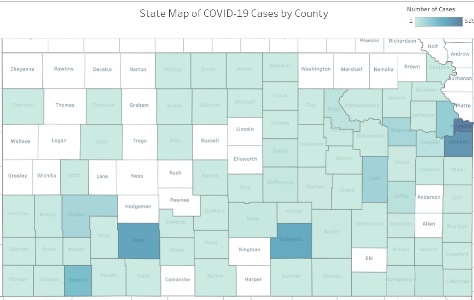
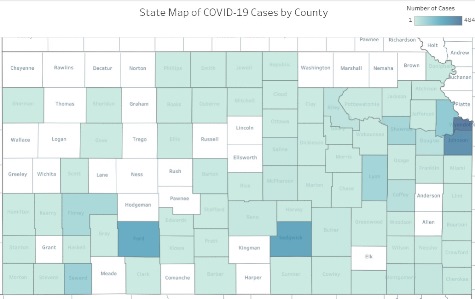
COVID-19 cases increased by 295 on Friday. (KDHE map)
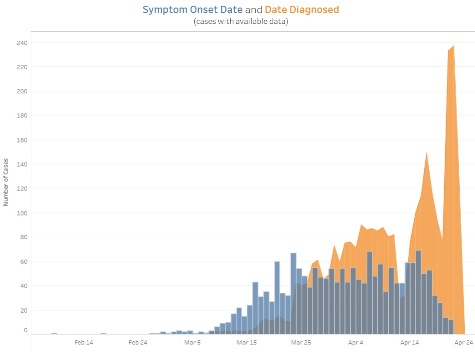
This chart showed symptom onset date in blue and date diagnosed in yellow, for statewide COVID-19 cases in Kansas. (KDHE chart)
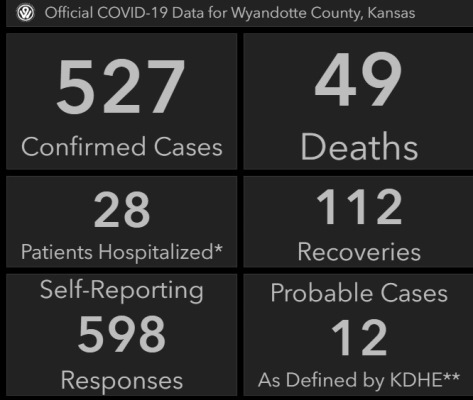
Wyandotte County reported 527 cases and 49 deaths on at 4:10 p.m. Friday, according to the Unified Government COVID-19 website. That included two more deaths than Thursday evening. There was an increase of 37 cases. (From UG COVID-19 website)
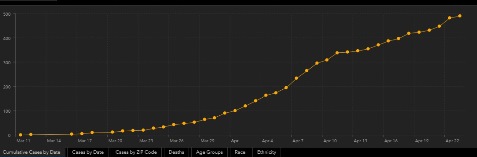
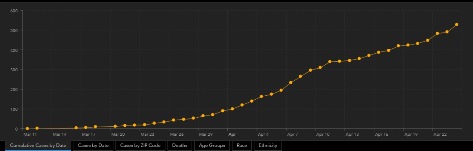
A graph from Friday showed the rise of Wyandotte County cases. (From UG COVID-19 website)
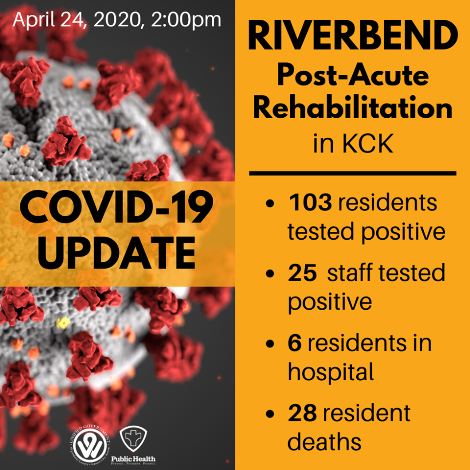
Eleven more Riverbend residents have tested positive and one more has died, according to information from the UG Health Department. (UG Health Department graphic)
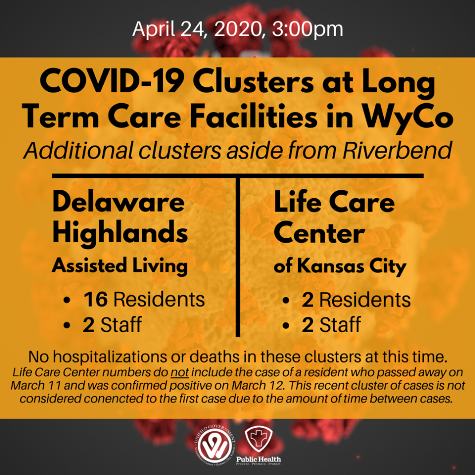
Two more nursing homes in Wyandotte County have clusters of cases, according to the UG Health Department. (UG Health Department graphic)

Kansas saw its highest increase of positive COVID-19 cases on Friday, increasing 295 for a total of 2,777, according to Gov. Laura Kelly.

COVID-19 cases now are in 76 of the 105 Kansas counties, according to state health statistics. There was a reduction from 112 deaths on Thursday to 111 deaths on Friday because someone was misdiagnosed, according to officials.

Wyandotte County reported 527 cases and 49 deaths at 4:10 p.m. Friday, according to the Unified Government COVID-19 website. That included two more deaths than Thursday evening. There were 490 cases on Thursday evening, for an increase of 37 more cases in Wyandotte County.

The number of deaths at the Riverbend Post-Acute Rehabilitation facility at 78th and Freeman in Kansas City, Kansas, is now up to 28, the UG Health Department reported today. The number of residents testing positive for COVID-19 has increased to 103, the Health Department reported. All the residents were tested previously, with a small number who were negative, and a retest showed some of the residents who were formerly negative were now positive, the Health Department stated. Those who tested negative were assigned to a separate floor, according to the Health Department.

The UG Health Department also reported today two more nursing homes in Wyandotte County have clusters of cases. Delaware Highlands Assisted Living, 12600 Delaware Parkway, Kansas City, Kansas, has 16 residents and two staff members who tested positive, according to the Health Department. The Life Care Center of Kansas City, 3231 N. 61st, Kansas City, Kansas, had two residents and two staff members who tested positive, the Health Department stated.

There were no hospitalizations or deaths in these clusters at this time, according to the report.

The Life Care Center numbers did not include the case of a resident who died March 11 and was confirmed positive on March 12, the first death related to COVID-19 in Wyandotte County. The recent cluster of cases was not considered connected to the first case because of the amount of time between cases, the Health Department stated.

“We feel optimistic that Kansas is close to reaching its peak,” Gov. Kelly said in a news conference today, “if we haven’t already.”

If so, they are heading to a downward slope and should be able to proceed with plans for recovery, which they will be announcing next week, she said.

Gov. Kelly said three plans would move ahead at once. First, the state will make sure it is developing a plan to disburse federal dollars into the Kansas economy as quickly as possible, she said.

Also, the state will announce guidance on reopening the Kansas economy in phases, she said.

Third, the state must identify a strategy to manage cash flow and address an imminent budget crisis, she said. On Monday, the state heard a report that it was a $1.27 billion shortfall, and Gov. Kelly has been working on it with the budget director this week.

“The slowdown in the economy brought on by the spread of COVID-19 has caused our state’s budget situation to deteriorate rapidly,” Gov. Kelly said.

If the state wants to protect all the progress it has made in recent years in the schools, the correction systems, and the infrastructure, then Kansas will need help to get it through this, she said.

Federal aid approved by Congress on Thursday will inject more money into the economy for small businesses, economic disaster loans and grants, she said. It also provides aid for hospitals that have scaled back while investing more money in fighting COVID-19, she said.

The federal package also boosts funding for expanded testing capacity, she said. This will be crucial for determining when it will be safe for Kansas to reopen, she said.

Gov. Kelly also said there is need for additional funding in direct, flexible state aid.

“I am gravely concerned that Kansas is prohibited from using CARES Act funds to replace general fund revenue,” she said. She added there was a need for local government funding as well.

“If the federal government fails to act, we will be forced to make very deep cuts to critical services,” Gov. Kelly said.

She said there is a key difference between the $1 billion cuts Kansas made during the Great Recession and the over $1 billion shortfall Kansas faces today. The Great Recession cuts, while brutal, occurred gradually, she said, and communities had a chance to adapt and prioritize to limit the damage as much as possible. Without aid from the federal government, the state will be forced to make all the cuts in just one budget cycle, she said.

Gov. Kelly said she was alarmed and frustrated at statements at the federal level that the states should just file for bankruptcy. “I don’t even know what that means,” she said.

From her first week in office, she has said it wasn’t a matter of if the state would face a downturn, but when and how bad, she said.

“But no one, not even the federal government, anticipated a downturn of this scale and this speed,” Gov. Kelly said.

Today, Gov. Kelly sent a letter to the federal delegation about the severity of the state’s situation, and requested support of a relief package that includes flexible, direct state aid, she said.

“Our ability to recover from this public health pandemic and revive our state economy hinges upon the state’s ability to pay its bills,” she said. “Kansas communities rightfully expect state government to fund public education, they expect a strong public health system, public safety, a safety net for seniors and an adequate technology infrastructure to insure that public resources will be accessed in a timely manner. Without flexible federal aid, Kansas will find itself unable to fulfill these obligations when they are needed most.”

Dr. Lee Norman, Kansas health secretary, said the state is monitoring 52 clusters.

They include 19 in long-term care facilities, with 377 cases and 63 deaths; two group living arrangements, 28 cases and no deaths; correctional facilities, Lansing Correctional Facility, 82 cases and no deaths; two in health care facilities, with 16 cases and no deaths; five religious gatherings, 88 cases and eight deaths; and 17 in private companies, 99 cases and four deaths.

The one thing the companies have in common is people were close to each other, Dr. Norman said.

Accounting for a recent uptick in cases recently are six meatpacking plants, with 250 cases and no deaths, he said.

CDC staff have landed in Kansas and have started attending incident command meetings, he said. Three of the staff are located in southwest Kansas, working directly with the meatpacking plants. Four staff members are in Topeka working with epidemiologists and the team, he said.

The state lab now has received its first shipment of 3D printed swabs, and now testing can go forward, They are now shifting from just testing ill people, to testing the general population, he said. They will try to get to five tests per thousand in population to understand the prevalence of the disease. Some counties already are at that level, he said.

Dr. Norman said there is marked improvement in hospitalization and death numbers in Kansas. Although more time is needed to be certain, the trend line is favorable, he said.

He said he believes the state has reached its peak in hospitalizations and deaths, however, the total number of cases could continue to go up.

The state may continue to have more positive tests and more positive in tests per capita, he said, because of increased testing capacity. That is a good thing because they will know where the disease is and can go out to those areas and stop the spread of the disease.

He said they may see a lower percentage of positives. Dr. Norman said people in Ford County, the Dodge City area, have been remarkably symptom free or with mild symptoms. They need to continue public health messaging and monitoring of where they are in their communities as they interact with their families and communities.

Other counties’ reports, according to the KDHE: Johnson County, 417 cases; Ford (Dodge City area), 350 cases; Sedgwick (Wichita area), 323 cases; Seward (Liberal area), 232 cases; Leavenworth County, 154 cases; Lyon County (Emporia area), 126 cases; Finney (Garden City area), 107 cases; Shawnee (Topeka area), 99 cases; Coffey (Burlington area), 48 cases; Douglas (Lawrence area), 46 cases; and Riley County (Manhattan area), 40 cases.

To see the governor’s news conference, visit https://www.facebook.com/GovLauraKelly/videos/2345585855750206/.

The Kansas COVID-19 resource page is at https://govstatus.egov.com/coronavirus.

The UG’s COVID-19 webpage is at https://alpha.wycokck.org/Coronavirus-COVID-19-Information.

Information from the CDC is at https://www.cdc.gov/coronavirus/2019-nCoV/.
More federal funding to go toward testing for COVID-19

by Mary Rupert

U.S. Sen. Jerry Moran said today that more federal funding will go toward testing for COVID-19, including $21 million for more testing in Kansas.

He also discussed funding for small businesses. Congress recently passed a replenishment of the Paycheck Protection Program fund, where the Small Business Administration guarantees loans to small businesses of less than 500 people, he said.

Kansas received $4.28 billion in nearly 27,000 businesses in the first phase, keeping 427 jobs in the state, he said.

Sen. Moran said the money in the first fund was utilized rapidly, the funds were depleted, and the House on Thursday passed legislation adding $310 billion. This is generally an economic bill, having the effect of people allowed to keep their jobs and remain at home, while not having to be at work to receive the wage, he said.

Sen. Moran made his remarks at a news conference Friday morning sponsored by the University of Kansas Health System.

Also, $75 billion more will go to hospitals and another $25 billion will be directed toward testing, Sen. Moran said.

This legislation will provide $21 million to Kansas to increase testing to accomplish the goal of broader testing in Kansas, Sen. Moran said.

Also this week, the Department of Health and Human Services provided the second part of funding from the original $100 billion, and it has been enhanced by another $75 billion, he said. This payment will be based more on Medicaid reimbursement than Medicare reimbursement, he said.

Sen. Moran said his focus for the last few weeks has been making the PPP program available to all hospitals, and unfortunately, the public hospitals in counties, districts and cities have been excluded. He is still lobbying on this topic to make sure some hospitals are not being left out in being able to continue to pay their employees, he added.

Dr. Jessica Kalender-Rich, a doctor of general and geriatric medicine, said they have seen a lot of efforts to ramp up the ways in which residents of nursing homes are protected.

She said they are working hard to provide residents with therapy and what they need, in addition to using a lot of personal protective equipment around them that was not always used in the past because it was not always indicated. Residents are more isolated than usual, with visitors not allowed in nursing homes. She said in many cases, residents have been taught to use iPads and Facetime to connect with their loved ones. Some of the homes allow visits to persons who are at the end of life, she added.

Dr. Kalendar-Rich serves on the Wyandotte County task force recently formed on nursing homes. They are developing guidelines, taking guidance from Centers for Disease Control and Centers for Medicare and Medicaid Services to help facilities create their own policies to protect residents.

She said there is currently testing for COVID-19 in nursing homes for patients who have symptoms, based on the availability of testing supplies and also on the opportunity to get out there and do those tests. She said that will probably change over time.

When there is a positive test, then there is an opportunity to test the entire building, she said. The guidance on that is not fully developed yet at the county level, but that is what they have seen in other parts of the country, she said.

The Unified Government Health Department’s COVID-19 webpage at 10:15 a.m. Friday reported 518 positive COVID-19 cases in Wyandotte County, with 48 deaths. It was an increase of 28 cases from Thursday evening, and an increase of one death since Thursday.

On Friday, the KU Health System had 24 COVID-19 patents hospitalized, with 11 in the intensive care unit, according to Dr. Dana Hawkinson, medical director of infection prevention and control at the University of Kansas Health System. He said some patients continue to get well, with one moved off intubation on Thursday.

Dr. Steve Stites, chief medical officer at KU Health System, said the area has done a good job of flattening the curve. As society opens up again, the next big challenge is to keep it that way. It’s about personal responsibility, he said. Residents need to make sure they keep six feet of distance, practice good hygiene, and those who are sick shouldn’t go out.

The UG’s COVID-19 webpage is at https://alpha.wycokck.org/Coronavirus-COVID-19-Information.

The Kansas COVID-19 resource page is at https://govstatus.egov.com/coronavirus.

Information from the CDC is at https://www.cdc.gov/coronavirus/2019-nCoV/.
To reach Mary Rupert, editor, email maryr@g3f.1db.myftpupload.com.

Extra $600 goes to Kansans on unemployment today

COVID-19 cases increase 271 today in Kansas

Kansas experienced its largest increase in COVID-19 cases today, rising 271 to a total of 2,482. There were two additional deaths statewide. (KDHE map)

An extra $600 weekly payment for those receiving unemployment benefits went to recipients today, according to Kansas Gov. Laura Kelly.

It was part of the federal legislation passed by Congress to address the COVID-19 pandemic effects.

“A processing issue that has delayed implementation of the $600 weekly payment has been resolved, and the Department of Labor will be processing more than $3.4 million in benefits today,” Gov. Kelly said at a news conference. The $600 is in addition to the regular unemployment payments.

In addition, Gov. Kelly has directed the state Department of Labor to evaluate all its processes and procedures for handling worker compensation claims filed by first responders and health care workers that are related to the pandemic. The state will submit a temporary regulation and develop a draft of legislation for workers who get COVID-19 while part of their employment.

Kansas Secretary of Labor Delia Garcia said the $600 payments would go automatically to those receiving unemployment and no additional action was needed on the recipients’ part. The state now has Spanish language information at www.getkansasbenefitsnow.gov, at a top right button on the website, she said.

Gov. Kelly reported that Kansas has 2,482 positive COVID-19 cases on Thursday, up 271 cases from Wednesday. There were 112 total deaths in the state, up two from Wednesday. Seventy-four of 105 counties have reported positive cases.

Kansas had an increase of 186 cases on Wednesday, and the Thursday increase is now the largest increase to date in Kansas.

Gov. Kelly answered a question about name-calling by protesters in Topeka who demonstrated their opposition to the stay-at-home order today. Hundreds of protesters were there. She said she worked many years with adolescents, so there was no name she hadn’t been called at some point in her life. Als

“I understand your frustration,” Gov. Kelly said. “I’m as frustrated by this.”
She said she wished she could snap her fingers and have it all over with, but she can’t, and they have to pay attention to the science and reopen the economy as health indicators will allow. There are three phases in reopening, and each includes some steps, such as enough testing to determine the extent of the virus.

Kansas is still in need of testing supplies, Gov. Kelly said, and she has been asking federal agencies to provide them.

She said she has talked with industries across the state this week, as well as the tourism industry, chambers of commerce, small businesses and others to prepare for lifting the orders on May 3. They may not be able to lift the order on May 3, but it was the state’s original intent to do so, she added.

Gov. Kelly said states need additional federal funding to address shortfalls from the last few months, including extending the tax filing deadlines. The state is estimated to be down $1.3 billion for the next two years. She said the third stimulus bill will include some assistance from the federal government, but more will be needed.

Total positive cases up 17 in Wyandotte County

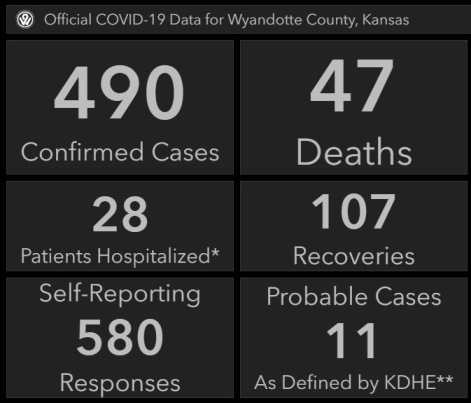
Wyandotte County reported 490 total cases and 47 total deaths at 4 p.m. April 23, according to the Unified Government COVID-19 webpage. Wyandotte County had 473 cases at 4:40 p.m. April 22, an increase of about 17. There were the same number of deaths as the late report April 22.

Testing was expanded this week by the Health Department in Wyandotte County. For information about how to get a test and times available, visit https://www.wycokck.org/WycoKCK/media/Health-Department/Documents/Communicable%20Disease/COVID19/ExpandedCOVID-19testinginWyCo.pdf.

Mayor launches Re-Start WYCO Committee

Mayor David Alvey announced today he was launching a Re-Start WYCO Committee.

The committee has already held one meeting, according to a spokesman, and is scheduled to meet again on Friday.

The group includes health and business leaders. It will not decide when to reopen or relax guidelines, but it will provide guidance on how to safely reopen when the time comes, according to a spokesman.

Dr. Allen Greiner, chief medical officer of Wyandotte County, will advise the county on when to reopen, based on all the data available, according to the spokesman. The co-chairs are Dr. Greiner and UG Commissioner Brian McKiernan.

“We recognize the hardship this pandemic is placing on families and businesses across Wyandotte County, and I am heartened by our community’s commitment and sacrifice to protect its most vulnerable,” stated UG Mayor David Alvey, in a news release. “We need a strategy and a plan that focuses first on health, but also addresses the need to gradually restore and re-open our community at the appropriate time, and in a manner that doesn’t undo our previous efforts to combat COVID-19.”

KU Health System planning additional testing

The University of Kansas Health System is planning additional COVID-19 testing as it is scheduled to receive additional equipment allowing them to handle perhaps 1,000 tests a day, according to doctors at a news conference Thursday morning.

KU Health System also is participating in a trial for patients using convalescent plasma, according to the doctors.

Dr. Steve Stites, chief medical officer at the KU Health System, said that the KU Health System is gearing up to resume some elective surgery soon.

He said procedures are being put in place to make sure that the patients will be safe. There could be some changes, such as waiting in vehicles instead of in a waiting room, in the future.

He said the doctors were concerned that people have been delaying health care during the COVID-19 pandemic across the country. He urged people to take care of chronic medical problems, such as heart problems.

KU Health System reported 23 COVID-19 inpatients, 12 in the intensive care unit, and 69 to 70 discharges on Thursday, according to Dr. Dana Hawkinson, medical director of infection prevention and control.

Other county COVID-19 totals

Seventy-four Kansas counties reported positive COVID-19 patients on Thursday.

Some of the largest numbers, besides Wyandotte County, included Johnson Count, 403; Ford County, 288; Leavenworth County, 154; Lyon County, 105; Finney County, 87; Coffey County, 48; and Douglas County, 44.

To see the governor’s news conference, visit https://www.facebook.com/GovLauraKelly/videos/3247224465502124/.

To see the KU Health System news conference, visit https://www.facebook.com/kuhospital/videos/615755085675997/?tn=%2Cd%2CP-R&eid=ARCXe6Lj0JvWyLHYg6Xg5zxs1J6nnRGeWqeFt9ctoh4xifrT7r-9TdLmKPWHM9i_1eJLgWNf52EJf7-H

The Kansas COVID-19 resource page is at https://govstatus.egov.com/coronavirus.


The UG’s COVID-19 webpage is at https://alpha.wycokck.org/Coronavirus-COVID-19-Information.

To see more details about the mayor’s Re-Start WYCO Committee, visit https://www.wycokck.org/WycoKCK/media/Health-Department/Documents/Communicable%20Disease/COVID19/ReStartWYCOCommitteeFormed04232020.pdf.

There were 490 positive COVID-19 cases in Wyandotte County at 4 p.m. April 23, an increase of 17 from April 22 afternoon. The number of deaths, 47, was the same as April 22 afternoon. (UG COVID-19 webpage)
A chart showed the number of COVID-19 cases in Wyandotte County. (From UG COVID-19 webpage)
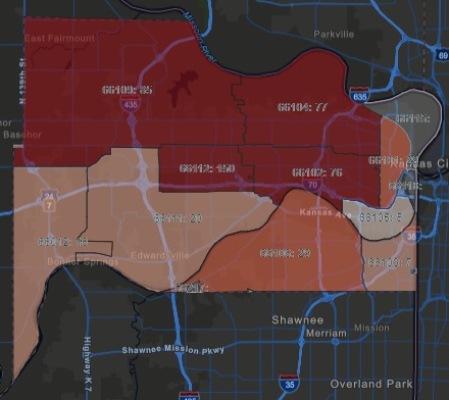
A map showed the number of COVID-19 cases by Zip Code in Wyandotte County on April 23. There wre 150 cases in 66112; 85 cases in 66109; 77 cases in 66104; 76 cases in 66102; 29 cases in 66101; 29 cases in 66106; 20 cases in 66101; 10 cases in 66012; and 7 cases in 66103. (Map from UG COVID-19 page)