Two University of Kansas Health System doctors will throw out the first pitch at the Kansas City Royals home opener game tonight, remotely.
Dr. Steve Stites, chief medical officer, and Dr. Dana Hawkinson, medical director of infection prevention and control at KU Health System, will throw out the first pitch.
The game at 6:30 p.m. Friday is being held without fans.
Dr. Vince Key, Royals team doctor, said it’s been challenging to keep the players and coaches safe and already, several have contracted the virus. With 60 players on the roster, he thinks they will be able to continue playing the entire season safely.
The team members and coaches take a saliva test for COVID-19 every other day, he said.
The players are very good at observing distancing, avoiding gathering together and eating out after the games, he said. The clubhouse has been redesigned to allow social distancing, and masks are required, he said.
There were 36 COVID-19 patients at the KU Health System Friday morning, up from 35 on Thursday. Ten patients were in the intensive care unit, a decrease of one from Thursday, and five patients were on ventilators, the same as on Thursday.
On Friday, Wyandotte County reported a total cumulative 4,374 COVID-19 cases, an increase of 49 since Thursday, according to the Unified Government COVID-19 website. There were no new deaths, the total remained the same at 95.
Kansas reported an increase of 1,042 positive COVID-19 cases from Wednesday to Friday, with an increase of nine deaths, according to KDHE statistics.
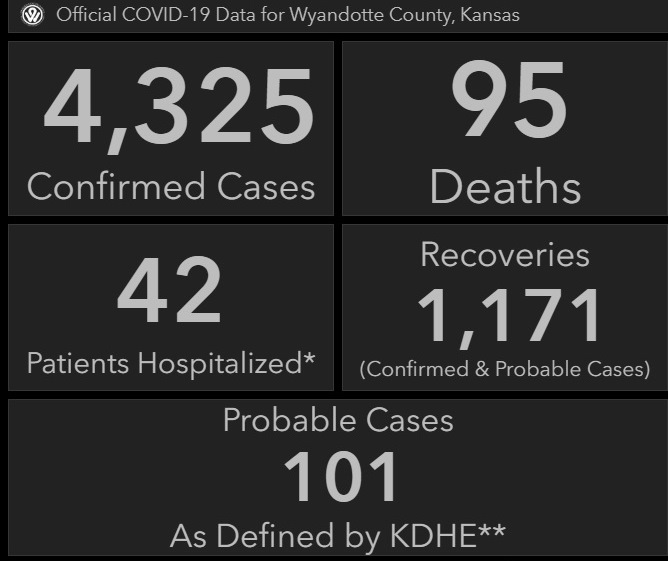
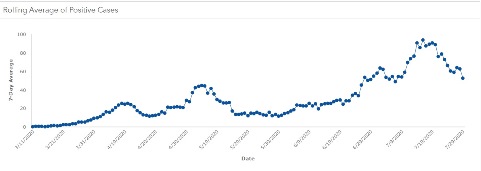
On Thursday, Wyandotte County reported an increase of 102 COVID-19 cases, a cumulative total of 4,325 cases at 1 p.m. There were 95 COVID-19 cumulative deaths, an increase of two since Wednesday. (From UG COVID-19 webpage)After hitting a spike in mid-July, the 7-day rolling average of positive COVID-19 cases has started trending down in Wyandotte County. (UG Health Department graphic)
Wyandotte County will continue in Phase 3 of the Ad Astra reopening plan, according to Dr. Allen Greiner, chief health officer of Wyandotte County.
Dr. Greiner made his remarks at the 5 p.m. July 30 meeting of the Unified Government, a remote meeting held on Zoom.
“The 7-day positive rolling average has come down in the past week,” Juliann Van Liew, Unified Government Health Department director, said about the COVID-19 positive rate.
The trend is very encouraging, she said. Jackson and Johnson counties are seeing different trends, with their rates not coming down like Wyandotte County’s has in the past few weeks, she said.
Dr. Greiner said it is possible that Wyandotte County’s downward trend came about because of the mask order that went into effect July 1 here. In Phase 3, gatherings cannot exceed 45 people where social distancing of 6 feet cannot be maintained.
While deaths in general have been declining over several weeks, Wyandotte County has had two COVID-19 deaths in the past day, Van Liew said. Some deaths recently have been related to outbreaks in long-term care facilities, she said. Overall, deaths remain relatively low, according to Dr. Greiner.
The percent positivity rate is still around 20 percent, which is higher than they want to see it, she added. Very few places here are doing testing on persons who don’t have symptoms, she added.
Van Liew also said COVID-19 case rates here among Hispanics are four times more than non-Hispanics, which is a concern for the Health Department. Testing has been increased in the Hispanic community through some outreach programs.
Also, Van Liew said the Health Department is significantly behind on contact tracing, lagging about 800 cases behind.
This is not unique, as almost every county in the metropolitan area is behind on contact tracing, she said.
In the past four to five weeks, the Health Department has hired two to three contact tracers every week, she said. It takes time for training, she added. About 15 people are now working full-time at contact tracing here, with about 10 to 15 volunteers helping, she added.
Being behind on contact tracing is a problem, since it’s only effective when it’s done soon, she said. The contacts of COVID-19 patients are likely to have been out in the community a while, if they are not contacted quickly.
Last week the UG Health Department held a contact tracing blitz, with 15 others from other UG departments joining in on July 14 to 15 to try to catch up with cases. Next week, they plan to do another contact tracing blitz from Aug. 3 to 7, she said.
Currently, the Health Department can do contact tracing of about 65 per day, she said. She said they don’t want to outsource the work because 40 percent of all traced cases report having a difficult time accessing food or cleaning supplies while quarantined, and the Health Department is helping people with this.
Dr. Greiner said the Health Department has found new pathways to get data abot hospitalizations. While some of the data sources from the federal level changed recently, the local hospitals are having regular meetings and are discussing their hospitalization rates, and have shared them with him. The Health Department is able to separate the Wyandotte County cases from the other cases for the statistical totals, he said.
It’s currently believed there is adequate hospital bed capacity right now, he said.
At the University of Kansas Health System, there were 35 COVID-19 patients on Thursday, up from 34 on Wednesday, with 11 patients in the intensive care unit, up from nine on Wednesday, and five patients on ventilators, the same as Wednesday, according to Dr. Dana Hawkinson, medical director of infection prevention and control at KU Health System.
He said it has been scientifically proven that masks work to stop the spread of the virus. Dr. Hawkinson noted that they are trying to change the culture at “warp speed.” He said that washing hands, wearing a mask and socially distancing work to prevent the spread of coronavirus.
Dr. Hawkinson said they are much better off than three or four months ago, with a vaccination in process, and clinical trials to begin in a few weeks here.
On Thursday, Wyandotte County reported an increase of 102 COVID-19 cases, a cumulative total of 4,325 cases at 1 p.m. There were 95 COVID-19 cumulative deaths, an increase of two since Wednesday.
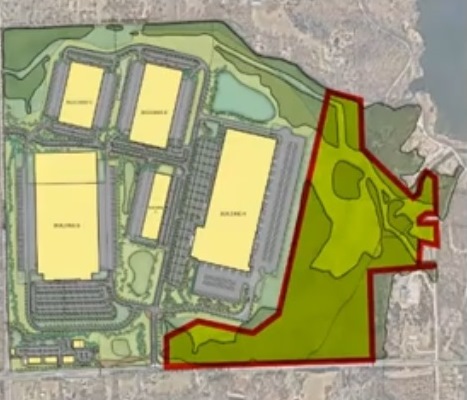
Plans for development of The Woodlands include five buildings. A 97-acre park-like area to the east, near Wyandotte County Lake, is proposed to be given to the Unified Government for parks. (From UG meeting)
On a 6-3 vote, the Unified Government Commission on Thursday night approved a warehouse redevelopment project for the former Woodlands horse and dog track at 97th and Leavenworth Road in Kansas City, Kansas. The Zoom meeting was online.
The redevelopment project is on 431 acres of property at 97th and Leavenworth Road, including the former Woodlands racetrack, and also Bennet Lake, according to developers. Wyandotte County Lake is nearby.
The owner of The Woodlands, Phil Ruffin, who also owns a casino in Las Vegas, is selling the track. During the past several years, the state legislature has failed to approve plans that would allow racetracks to keep enough gaming proceeds to reopen.
While nearby residents opposed the warehouse project, the offer apparently was too good for the UG to refuse, as the developer did not ask for incentives, paid the UG $2 million for some UG-owned property, agreed to put in sidewalks, gave land for parkland and agreed to help pay for trails.
At the public hearing Thursday, the commission heard from seven residents who were against the project, and one resident who was in favor of it.
The residents’ protest petition was thrown out, however. With a valid protest petition, nine votes would have been needed to pass the rezoning; without it, only six votes were needed.
Residents who lived near the proposed warehouse development said it did not fit with the character of their neighborhood.
“It’s like taking a bathroom and putting it in the middle of your living room, that’s how out of place it is,” said Laurie Torrez, a nearby resident.
Jeff Miles, a resident, was in favor of the project. He said he lived across from The Woodlands and is in favor of redeveloping the property. The redevelopment will be better than what they currently have, he said. He added the traffic and noise doesn’t bother him.
Rusty Roberts, a Realtor whose relative has an event center located near The Woodlands, also opposed the development, saying he believes real estate values will go down in the surrounding area a little. More studies need to be done on how it will affect the area, he said.
Karen Lauber, who lives near 99th and Leavenworth Road, said their experience with trucks and vehicles parked at The Woodlands previously was “a really bad experience, intolerable from the standpoint of noise with the trucks.”
Meghan LaDuke, a nearby resident, suggested moving the entrance so it is not directly across the street from residents. She said it will be hard for residents to get out on Leavenworth Road.
The zoning was changed from agriculture and planned general business districts to limited business and general industrial districts.
Gunnar Hand, UG director of planning, said the tops of the 60-foot buildings will be shielded by berms. There are sidewalks and trails planned with this project, also. There are plans for a traffic light on Leavenworth Road, according to Hand.
Hand said he focused on maintaining the character of the neighborhood and also mitigating the traffic impact. The berms and landscaping are intended to maintain the character of the neighborhood, while traffic will be focused on the main entrance on Leavenworth Road, according to Hand.
Shaun Cofer appeared at the meeting, representing Scannell Properties, an Indiana real estate development firm. According to the UG agenda, the proposal was to build five industrial buildings for warehousing distribution and manufacturing totaling 3.14 million square feet and 51 square feet of commercial retail. During Thursday’s meeting, officials said there would not be manufacturing on the site, but described it as warehouses and a business park.
The neighborhood retail center would be at the northeast corner of 99th and Leavenworth Road, according to the developers.
Each of the buildings would come back later before the UG Commission for approval, according to staff.
Seth Reece with Olsson Associates, representing the developer, said 97 acres to the east will be dedicated to the UG for a park. There are plans to put in trails and sidewalks, and the developer will provide funds for the trails, he said. Existing trees to the east and north of the project will be preserved, he said.
Reece said covenants will be added to the agreements to prevent the land from being used for heavy industrial purposes.
He also said the UG wants stoplights at the facility’s Leavenworth Road entrance and also at 103rd. He said the developer would be willing to assist with the costs if the traffic lights are approved by the Kansas Department of Transportation, which has authority over Leavenworth Road.
With the building in the first phase, there would be about 262 trucks a day going in and out of The Woodlands, according to Reece. The facility could operate 24 hours a day, seven days a week. There will be four shifts planned at the building in the first phase.
Greg Kindle, president of the Wyandotte Economic Development Council, supported the rezoning, saying that the current site hasn’t been used in nearly 15 years and is in significant disrepair. The project could bring 1,000 employees to the community, he said.
Kindle said the project would generate more than $1.9 million in property taxes the first year of operation. That includes $880,000 to the UG, $650,000 to the Piper school district and $300,000 to Kansas City Kansas Community College, he said.
“We are fortunate to have developers who want to invest in our community and be good neighbors,” he said. Plus, the project provides valuable jobs to those who have been laid off during the pandemic, he added.
Commissioner Mike Kane represents the district that The Woodlands is in, and voted against the project. He said almost all the calls he received were against the project, and he was voting with the residents. He also said since the facility operates 24 hours a day, it’s an industrial park, not a business park.
The proposed warehouse tenant for the development’s first phase was not disclosed at the UG Commission meeting. Also not disclosed by anyone at the commission meeting was how much the new jobs would pay.
During the discussion, Hand said the residents’ petition was invalid. When residents asked why it was thrown out, Hand said a protest petition required 20 percent of the residents of the land area, not the number of parcels, to sign a petition, and only 2.8 percent signed.
The commission also approved a Master Plan amendment for the Woodlands project on a 7-1 vote, with Commissioner Kane voting no and Commissioner Burroughs voting “pass,” saying he had a conflict of interest. The Prairie-Piper Master Plan had identified the Woodlands area as “entertainment” and the amendment changed it to “business park.”
At a public meeting on June 29 at the Venue at Willow Creek at the entrance to Wyandotte County Lake, about 45 people showed up, with most of them voicing opposition to the development, Commissioner Kane said.
At a UG committee meeting, a purchase agreement for Scannell Properties to buy 34 acres of Unified Government-owned land next to The Woodlands for $2.031 million was discussed.
According to UG Administrator Doug Bach at the July 30 meeting, the property was acquired by the UG in the past in a tax sale when real estate taxes could not be paid.
During a July 6 UG Committee meeting, committee members discussed how important this project was to the UG’s budget this year, with its $2 million payment to the UG. The UG is facing a shortfall in revenues.
At the July 30 meeting, Mayor Alvey said the $2 million certainly will not fill the UG’s budget hole. The shortfall was much greater than that. They had to make severe cuts to the budget, and they did not count on getting the $2 million, according to the mayor.
The mayor, mentioning another business park, also said he didn’t think the homes around the development would lose their value. He said if there isn’t economic development, the community would only see decline.
“There is no way out of this but economic development,” Mayor Alvey said. The community must take opportunities, hold developers to high standards and allow the development to happen, he said.
Commissioner Melissa Bynum, who voted in favor of the development, said she had heard from three residents against the project and a few in favor of it.
She said the project redevelops a blighted and vacant property and the proposed developer has a track record of quality development. They worked to mitigate as many of the residents’ concerns as they could, she said.
The project brings local tax dollars to the UG, Piper school and local governments. That’s a change from the current situation with the parcel, which has a lower property tax, thanks to decisions by the state Board of Tax Appeals, she said.
She also mentioned improvements to sidewalks and trails, and jobs that are coming to the county.
“What has to happen in order to have any chance of reducing the tax burden on residents is to grow our tax base,” Commissioner Bynum said. “Here’s a project to do exactly that.”
The vote was 6-3 in favor of the change of zone, with Commissioners Kane, Harold Johnson and Tom Burroughs voting no. Commissioners Bynum, Gayle Townsend, Brian McKiernan, Christian Ramirez, Jim Walters and Jane Philbrook voted yes.
In April 2019, when The Woodlands wanted to store vehicles on its lot, neighbors also opposed the noise and the traffic. At that time, the neighbors won concessions that prevented the business from driving trucks there at night.
The sale price of The Woodlands was earlier reported to be near $20 million.