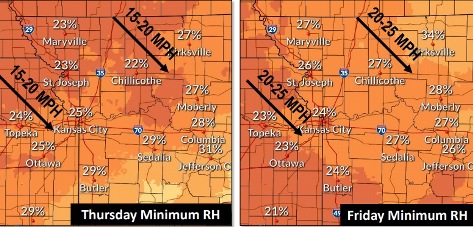
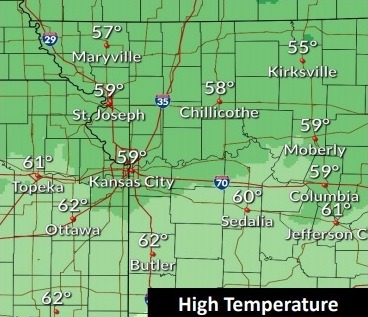
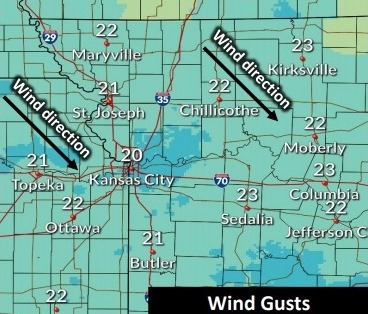
Relative humidity is dropping Thursday and Friday, leading to elevated fire weather. (National Weather Service graphic)Temperatures could reach a high of 59 today. (National Weather Service graphic)A north northwest wind of 10 to 13 mph may gust as high as 21 mph today. (National Weather Service graphic)
Elevated fire weather danger is possible this afternoon, as temperatures have dropped about 20 degrees this morning, according to the National Weather Service forecast.
The temperature was 51 degrees at 9 a.m. Thursday. Today’s temperatures will reach a high near 59, a sharp contrast to Wednesday, when temperatures reached the 80s, the weather service said.
This afternoon, humidity values will drop into the 20 percent to 30 percent range with northwesterly winds gusting to about 21 mph, according to the weather service.
Elevated fire weather danger also is expected on Friday and Saturday, the weather service said. On Friday, humidity values will drop to 20 percent to 30 percent with northwesterly wind gusts to 25 mph. Saturday, humidity values will drop to 25 percent to 35 percent, with southwesterly winds gusting to about 35 mph.
Although there is no freeze warning for Wyandotte County, temperatures could drop to a low of about 38 degrees tonight, according to the weather service. There might be frost on Friday morning.
Late Saturday or early Sunday, a front will push into the region, and could bring some light rain next week, although it is too early to say for certain. Next week will bring cooler temperatures and more fall-like weather, according to the weather service.
Today, it will be sunny with a high near 59 and a north northwest wind of 10 to 13 mph, gusting as high as 21 mph, the weather service said.
Tonight, it will be mostly clear, with a low of 38 and a north northwest wind of 6 mph becoming calm, according to the weather service.
Friday, it will be sunny with a high near 61 and a west northwest wind of 6 to 13 mph, gusting as high as 22 mph, the weather service.
Friday night, it will be partly cloudy, with a low of 47 and a light southwest wind becoming south 8 to 13 mph in the evening, according to the weather service. Winds may gust as high as 22 mph.
Saturday, It will be mostly sunny, with a high near 72, the weather service said. It will be breezy, with a south southwest wind of 15 to 20 mph, gusting as high as 36 mph.
Saturday night, it will be partly cloudy, with a low around 44, according to the weather service.
Sunday, it will be mostly cloudy, with a high near 55, the weather service said.
Sunday night, it will be mostly cloudy, with a low of 42, according to the weather service.
Monday, there is a 30 percent chance of rain before 1 p.m., the weather service said. The high will be near 54.
Monday night, it will be mostly cloudy, with a low of 40, according to the weather service.
Tuesday, it will be partly sunny, with a high near 56, the weather service said.
Tuesday night, it will be mostly cloudy, with a low of 44, according to the weather service.
Wednesday, it will be partly sunny, with a high near 62, the weather service said.
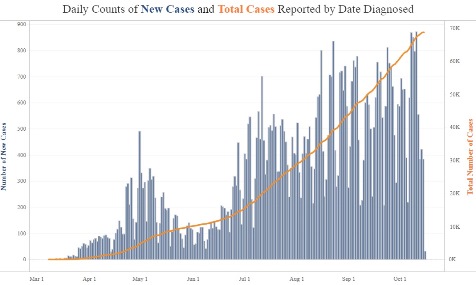
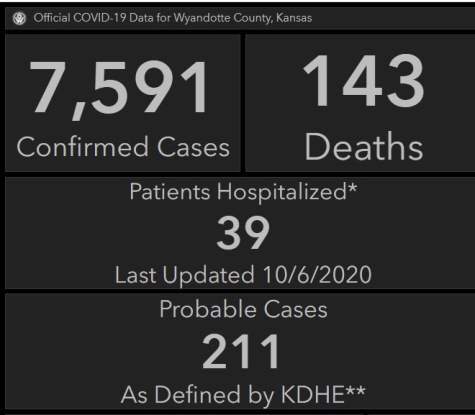
Daily new COVID-19 cases statewide in blue, and total cases in the orange line. The new cases are reported by the date of diagnosis. Kansas reported an increase of 1,293 COVID-19 cases on Wednesday, for a cumulative total of 69,155. There was an increase of 67 deaths for a cumulative 838, according to the KDHE. (KDHE graphic)Wyandotte County reported 7,591 cumulative COVID-19 cases, an increase of 66 since Tuesday, according to the Unified Government COVID-19 website. There was one additional death, for a cumulative total of 143. (From UG COVID-19 webpage)
Kansas remains in the “red zone” for COVID-19 case numbers and also for deaths from COVID-19, according to Dr. Lee Norman, Kansas secretary of health.
Dr. Norman said the White House weekly report on Wednesday morning showed that Kansas had 164 cases per 100,000, compared to 100 casese per 100,000 for the United States as a whole.
Also, Kansas had 2.2 COVID-19 deaths per 100,000, compared to the national average of 1.5 per 100,000, he said at a news conference Wednesday afternoon. The average of the Federal Emergency Management Agency’s Region 7, including some Midwest states, was 2.9 deaths per 100,000, and Kansas is lower than that, he added.
Kansas also was in the “orange zone” for its positive test rate of 8.3 percent, compared to the national average of 5.8 percent, he said. Also, Kansas was in the “green zone” for lab testing at 1,952 per 100,000, compared to the U.S. average of 2,113 per 100,000, he said. Kansas performed better than Region 7 in the lab testing category.
Dr. Norman said Wyandotte, Sedgwick and Johnson counties together account for 35 percent of the new cases in the state. The rest of the new cases are in the other 102 counties, he said. The larger number of new rural cases has been going on for a few weeks now.
Dr. Norman said there were some mutated versions of COVID-19, and that there are now a few documented cases of people who have gotten it twice. In the future, perhaps a vaccine may contain protection against the different mutated versions.
However, Dr. Norman didn’t think they would see a COVID-19 vaccine released for the public before the end of this year.
As they continue to see an uptick in case numbers, everyone must remain vigilant, he said, and continue to wear masks, socially distance, wash hands and avoid gatherings. One of the most dangerous things are large groups of people gathering together closely without masks on, he said.
Since both flu and COVID-19 will be spreading this fall and into the winter, it’s important to get a flu vaccine, he said, as it will protect the person who gets it and also the community.
Kansas reported an increase of 1,293 COVID-19 cases on Wednesday, for a cumulative total of 69,155, according to Dr. Norman. There was an increase of 67 deaths for a cumulative 838, according to the KDHE.
Dr. Norman said 60 of these 67 deaths were identified through a death certificate and reports review by the Office of Vital Statistics. Typically patients die in hospitals, and their reports don’t always come back to the health departments immediately, he said.
Wyandotte County reported 7,591 cumulative COVID-19 cases, an increase of 66 since Tuesday, according to the Unified Government COVID-19 website. There was one additional death, for a cumulative total of 143. The UG’s percent positivity rate was 17.3 percent, according to the UG COVID-19 website. The seven-day rolling average of the percent positivity rate was 12.8 percent on Oct. 13, according to the UG COVID-19 website.
Dr. Dana Hawkinson, medical director of infection prevention and control at the University of Kansas Health System, said there were 26 COVID-19 inpatients Wednesday morning at KU Health System, a decrease from 30 on Tuesday, with seven in intensive care and six on the ventilator, the same number as Tuesday. There were 33 COVID-19 patients in the hospital in the recovery phase, an increase from 28 on Tuesday, he added. HaysMed in Hays, Kansas, had 18 active COVID-19 inpatients, which is high for the hospital, he said.
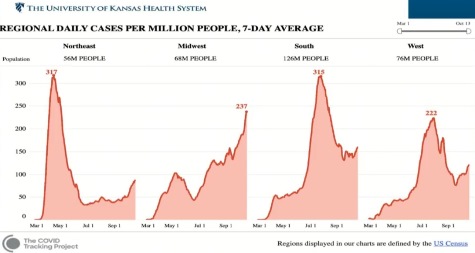
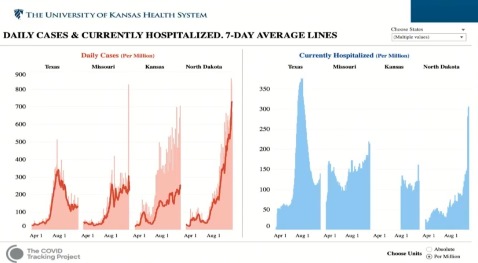
Dr. David Wild showed a graph at a news conference on Wednesday, displaying the recent spike in COVID-19 cases in the Midwest, as compared to other parts of the nation. (Graph from the COVID Tracking Project, displayed at the KU Health System news conference)A seven-day average of daily cases, on the left, with Kansas third from left, compares the state to Texas, Missouri and North Dakota. At the right side, in blue, are hospitalization rates for the four states. (Graph from the COVID Tracking Project, displayed at the KU Health System news conference)
At a news conference Wednesday morning at the University of Kansas Health System, Dr. David Wild, vice president of performance improvement, said the Midwest has the highest rate of new COVID-19 cases in any region of the country, when adjusted for population.
COVID-19 is affecting smaller hospitals in Kansas, such as one in Pittsburg, Kansas, where they had so many COVID-19 patients that they closed other services, except for emergencies, he said.
Some of the smaller communities are not able to staff police and fire departments, and other essential services, because of quarantines, he said.
In general, the hospitals in the Kansas City area still have space for patients, although they have seen increases in the past weeks, but one or two of the hospitals in the smaller towns may be starting to fill up.
Dr. Wild said he believes the differences in the Midwest numbers and other regions have something to do with less mask-wearing and social distancing.
“Regionally, we have a lot of work to do,” he said.
Dr. Wild said the nation is in the upswing of a third wave. Whether it is a true surge that challenges the delivery of health care, they have yet to see, he added.
Health experts are concerned that the stair step of cases will lead to higher levels of new cases and new hospitalizations. Generally, hospitalizations follow cases. Data across seven months showed that as cases went up, hospitalizations went up, he said.
Dr. Wild showed a graphic of some Swiss cheese slices, with holes in them, that were in a line. He said it’s like trying to prevent COVID-19 with some imperfect methods. The slices represent wearing a face mask, socially distancing, washing your hands and rapid testing. Each layer is not perfect, but if you do each of the things, you can keep yourself safe, he said.
Dr. Hawkinson said trying to get herd immunity with COVID-19 is not a good idea. It was tried in Sweden and didn’t work.
Usually, the term means that 90 percent of the population have immunity based on prior infections or vaccinations.
Now, doctors are not sure that people can get herd immunity with COVID-19, as they are starting to see re-infections of people who have already had it once, he said. There is a tragic case of a woman who died from a second infection, he said.
Dr. Wild said they are not sure yet how long immunity would last after people are infected with COVID-19. When people get the common cold, they can get it again later that year or the year after, he said. It’s different with immunity from chicken pox, where the immunity lasts longer, according to Dr. Wild. When people are re-infected with COVID-19, they could get a version with different genomic sequences that they may not have immunity against, according to Dr. Wild.
Instead, health experts here are trying to test people with COVID-19 symptoms and isolate the ones who test positive, to prevent COVID-19 from spreading.
Dr. Hawkinson said they are seeing an unfortunate time now, with a surge or wave, and increases around the nation, including Kansas. It is starting to affect the work force and supply chain, he said.
Everyone needs to remain vigilant, avoid gatherings, distance, wear masks and practice good hygiene, he said.
“Don’t be gathering,” he said. At their program on Tuesday, a COVID-19 recovering patient talked about getting COVID-19 at a small gathering of friends watching a football game on television. People want to get together, he said, but they should be careful and continue practicing good hygiene, distancing and wearing masks.
He also mentioned a spin class in another state where 61 cases resulted, even though the class was doing everything for preventing COVID-19 that was recommended. The virus spreads efficiently, he said, and there is a risk in meeting in groups.
Free testing continues on Thursday
Free tests are available from 4 p.m. to 6 p.m. Thursday, Oct. 15, at Vibrant Health Argentine location, 1428 S. 32nd St., Kansas City, Kansas.
The tests are available through the Wyandotte County Health Equity Task Force and Vibrant Health.
Free tests also continue from 9 a.m. to 3 p.m. Monday to Friday at the UG Health Department, 619 Ann Ave., Kansas City, Kansas.
The tests now are open to asymptomatic people as well as those who have symptoms or have been exposed to COVID-19. Check with the UG Health Department’s Facebook page to see if there have been any changes in the schedule because of the weather or for other reasons.
Next week, the Health Department testing location is changing to the former Kmart parking lot at 78th and State.
I have lived my entire life in Wyandotte County and have been in public service for 20 years. I am a passionate advocate for our community and will continue to use my experience and skills to improve the lives of Wyandotte County residents and give them a voice in Topeka.
What are the three most important issues facing this district and how would you handle them?
We need to continue our strong response to the COVID crisis. I believe that we should listen to the experts and proceed in a way that protects the health of our residents while rebuilding our economy. We need to get control of the virus through better testing and contract tracing and provide more PPE for frontline workers so that we can fully reopen our economy and get Kansans back to work.
Wyandotte County currently has one of the lowest health rankings in the state. We need to expand Medicaid so that more people have access to healthcare.
We need to lower the food sales tax so Wyandotte County residents have better access to healthy meals for their families. Working families pay enough as it is. They shouldn’t need to worry about paying one of the highest food sales taxes in the country.
If you are an incumbent, list your top accomplishments in office. If you are not an incumbent, what would you change if elected?
I have received a national award for my work with mental health issues and have also been recognized twice as Public Official of the Year by the Association of Community Mental Health Centers of Kansans and recently received their Legislative Champion for Community Mental Health award. I received an award from KU Cancer Center for legislation that I helped pass, including expanding funding for cancer research and treatment. I led the effort to pass legislation to keep guns out of public hospitals, community mental health centers and state psychiatric hospitals. I received a Distinguished Service Award from Friends of Yates for my work on behalf of victims of domestic violence. In 2018, I was inducted into the Kansas Children’s Service League Hall of Fame.
Have you run for elected office previously? When, results?
I have held this office for the past 10 years. This is the only elected office that I have held.