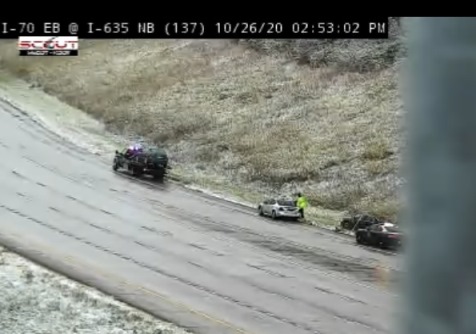
Accident reported at I-635 and I-70
Serving Kansas City (Wyandotte County) Kansas for over 50 years!

by Celia Llopis-Jepsen, Kansas News Service
Kansans remain among the most vulnerable in the country to surprise medical bills — charges from outside an insurance network that the consumer only discovers after treatment.
A new research brief from the Kansas Health Institute points to studies suggesting the charges are common in Kansas. It’s part of a shrinking minority of states yet to pass laws reining in the practice.
Surprise medical bills happen when a patient gets care at an in-network hospital, clinic or doctor’s office, only to get hit with third-party, out-of-network bills for services such as anesthesia or lab tests.
Other times, medical emergencies land people in ambulances and emergency rooms where their insurance doesn’t help much.
In both scenarios, the surprise charges result from services where the patient had no choice between out-of-network and in-network options.
Figuring out how common this is isn’t easy. Pricing and billing practices are proprietary information largely hidden from the public’s view. There is no complete national data to turn to.
But researchers use a variety of insurance databases and other sources to gauge the situation as best they can.
The Health Care Cost Institute has built up one such trove. When it scoured more than 600,000 claims for people who sought in-network inpatient care in 37 states, Kansas came second only to Florida for the highest rate of out-of-network charges.
One in four patients in Kansas ended up with out-of-network services through an in-network hospital.
Researchers who dug into another database with 19 million claims from 40 states found Kansas ranked fifth for how often emergency room patients got those out-of-network charges. The Kansas News Service reported on that research earlier this year.
A proposal to curb surprise medical bills failed in the Kansas Legislature last spring. Other statehouses did pass such legislation this year, however, bringing to 31 the total number of states with at least some consumer protections against surprise billing.
Other ideas to require doctors and hospitals to give patients better cost estimates prior to care also failed to pass the Kansas Legislature this year.
Health care providers say calculating meaningful estimates is difficult because various billers can exist under a single roof and a patient’s care may prove more complex than originally thought. They also say patients would need to understand how the estimates fit with their own insurance plan deductibles and copays.
Hospitals are appealing a new Trump administration rule in court that could soon force them to make their prices public.
The Kansas Health Institute is a nonprofit research group that receives funding from the Kansas Health Foundation, one of the Kansas News Service’s financial supporters.
Celia Llopis-Jepsen reports on consumer health and education for the Kansas News Service. You can follow her on Twitter @celia_LJ or email her at celia (at) kcur (dot) org. The Kansas News Service is a collaboration of KCUR, Kansas Public Radio, KMUW and High Plains Public Radio focused on health, the social determinants of health and their connection to public policy.
Kansas News Service stories and photos may be republished by news media at no cost with proper attribution and a link to ksnewsservice.org.
See more at https://www.kcur.org/news/2020-10-22/kansas-is-among-a-shrinking-number-of-states-that-dont-protect-people-from-surprise-medical-bills
A federal prosecutor will be on duty on Election Day to respond to complaints of possible election fraud or voting rights violations in Kansas, U.S. Attorney Stephen McAllister said recently.
McAllister said he has appointed Assistant U.S. Attorney Jared Maag to serve as the District Election Officer for Kansas. Maag will be responsible for overseeing the handling of complaints of election fraud and voting rights concerns in consultation with Justice Department officials in Washington.
Maag will be available to the public at 785-295-2858 while the polls are open on Nov. 3.
“I don’t expect any problems during voting,” McAllister said. “However, I want to remind Kansans that there are penalties under federal law for any efforts to influence the outcome of an election through fraud or to improperly prevent another person from exercising the right to vote. The Department of Justice has the authority to monitor polling places or take other measures to protect Kansans’ right to vote in free and fair elections.”
Federal law protects against such crimes as intimidating or bribing voters, buying and selling votes, impersonating voters, altering vote tallies, stuffing ballot boxes, and marking ballots for voters against their wishes or without their input. It also contains special protections for the rights of voters, and provides that they can vote free from acts that intimidate or harass them. For example, actions of persons designed to interrupt or intimidate voters at polling places by questioning or challenging them, or by photographing or videotaping them under the pretext that these are actions to uncover illegal voting may violate federal voting rights law. Further, federal law protects the right of voters to mark their own ballot or to be assisted by a person of their choice (where voters need assistance because of disability or illiteracy).
In addition, the FBI will have special agents available in each field office and resident agency throughout the country to receive allegations of election fraud and other election abuses on Election Day.
Complaints about possible violations of the federal voting rights laws can be made directly to the Civil Rights Division in Washington, D.C. by phone at 800-253-3931 or by complaint form at https://civilrights.justice.gov/
However, in the case of a crime of violence or intimidation, call 911 immediately and before contacting federal authorities. State and local police have primary jurisdiction over polling places and may have faster reaction capacity in an emergency.
“Ensuring free and fair elections depends in large part on the cooperation of the American electorate,” McAllister said. “It is imperative that those who have specific information about discrimination or election fraud make that information available to my Office, the FBI, or the Civil Rights Division.”