U.S. Rep. Sharice Davids, D-3rd Dist., on Friday issued a statement about the shortage of medical supplied that are needed to fight COVID-19 and keep frontline workers safe in Kansas.
“Kansas still doesn’t have the supplies we need to tackle this public health crisis,” Rep. Davids stated. “It’s unacceptable that we rank 50th among other states in per capita testing. And it’s unacceptable that our calls to FEMA for more supplies aren’t being met.
“Among other measures, the president needs to fully invoke the Defense Production Act to rapidly produce supplies and get them into the hands of our frontline workers. My team is working every day to help companies that want to donate or produce supplies and secure resources to our state.”
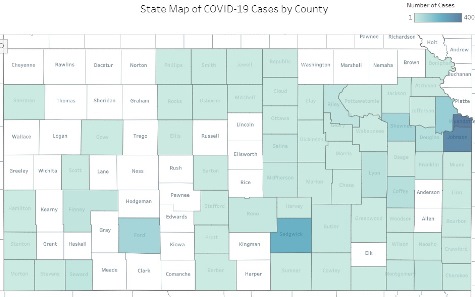
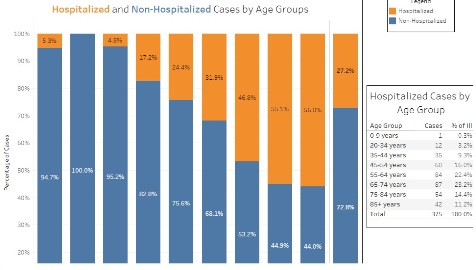
Sixty-six Kansas counties had positive COVID-19 cases on Friday, according to a KDHE map. There were 1,705 cases, an increase of 117, and a total of 84 deaths, an increase of four deaths. (Map from KDHE)This chart showed the number of hospitalizations in Kansas, by age group. (KDHE chart)
Gov. Laura Kelly today announced a “Hero Relief” program to expand child care assistance subsidies for families and provide financial support to child care providers.
Health care workers, first responders and other essential workers could receive child care subsidies beginning Monday, April 20.
In addition, child care providers could receive several stipends and grants for providing child care.
“We know these essential workers are risking their health every day to protect others,” Gov. Kelly said. “The Hero Relief Program is our way of saying ‘we’ve got your back’ by making sure families have access to quality affordable child care.”
Those who could receive child care subsidies would include health care workers, first responders in public safety, food and agriculture workers, judicial branch workers, the National Guard, child and adult protective service specialists and child care providers caring for children of eligible workers, according to the Department of Children and Families. Those whose gross income is at or below 250 percent of the federal poverty level could qualify. For example, a family of four that has a monthly income of $5,458 or less could qualify.
Kansas today saw an increase of positive COVID-19 cases, up 117 from Thursday for a total of 1,705. There were four more deaths in the state, for a total of 84, according to Kansas Department of Health and Environment statistics. Sixty-six of 105 counties had positive COVID-19 cases.
The Wyandotte County positive COVID-19 numbers were approaching 400 on Friday. There were a total 35 COVID-19 deaths reported in Wyandotte County. The 4:30 p.m. Friday UG COVID-19 page report stated there were 380 positive cases in Wyandotte County.
Gov. Kelly said during a news conference at 2 p.m. that she had signed another temporary executive order, 20-25, that further clarifies an older order on mass gatherings. The order is for 10 or fewer persons, who must be spaced 6 feet apart. The order narrows and better defines exemptions, she said, for restaurants, office spaces and grocery stores.
Gov. Kelly said the new order makes it clear that there have to be 10 or fewer people at a place, and they also have to be spaced 6 feet apart.
She said the limitations on mass gatherings are temporary, and her administration is working on a plan to reopen society as soon as possible. She said she has spoken with the White House, and is working with the state’s health and emergency team to get residents back to work as soon as possible.
She also said she was aware of lawsuits filed on behalf of churches that are challenging the order prohibiting gatherings. Gov Kelly said the executive order had nothing to do with religious freeom and everything to do with protecting the health and safety of Kansans.
Between now and May 3, the expiration date of the stay-at-home order, the state is working on a plan to reopen, most likely on a regional basis, she said. When the state order is lifted, local communities may decide whether or not to extend their own stay-at-home orders, she said. She added that if health conditions warrant, the state might have to extend its stay-at-home order.
Gov. Kelly said she was working with public health and emergency management agencies, and also the business world, to make a plan for reopening. She said she expected to have a plan late next week or the following week, with very clear guidelines.
The state’s ability to test and contact trace must be more robust before the state could safely reopen, she said. Gov. Kelly said she has been talking about the need for more testing and testing equipment for a long time, and the state has asked for more assistance from the federal government. Kansas has had to come up with some of its own solutions, she added. She said she pushed hard for Kansas to get its fair share of the tests.
Dr Lee Norman, Kansas secretary of health, said that some of the tests and supplies that should have been sent to Kansas were redirected to other, more populous states.
With the testing comes a need for more personal protective equipment, Gov. Kelly added. The state also needs more test kits, she said. She said she agreed with the president’s statement that more testing was needed, and she looked forward to his help in getting Kansas there.
Dr. Norman said 3D printing has begun and next week he anticipated they would have 10,000 swabs a week to do the testing. Some of these are being produced by dental offices.
Dr Norman said he estimated 15,500 tests would determine the prevalence of the spread of COVID-19 throughout Kansas. The testing will include nonsymptomatic people.
He said they expect that 30 to 40 percent of the asymptomatic cases are positive, which is what other studies have found.
COVID-19 is expected to reach a peak in Kansas in late April, Dr. Norman said. He said it is quite likely to have a resurgence of COVID-19 in the fall and winter, and the state needs to make sure it has enough ventilators. He said there should be some weeks after the peak, with a reduction of new cases, before any reopening.
Dr. Norman said the KDHE is currently monitoring 35 clusters statewide, an increase of nine from Wednesday. The nine are all in private companies, he said. The clusters include 13 long-term care centers, two group living sites, 13 in private companies, Lansing Correctional Facility, a hospital and five religious gatherings.
Lansing Correctional Facility currently has 65 confirmed cases, and six patients have recovered completely, he said.
During a news conference on Friday morning, U.S. Sen. Jerry Moran, R-Kansas, supported widespread COVID-19 testing.
The news conference was held by the University of Kansas Health System.
“Widespread testing is one of the most important factors in how we can safely get our lives back to normal and businesses can start to reopen,” Sen. Moran said during the news conference. “I have spoken directly with President Trump and a number of my colleagues in the Senate regarding testing, and I will continue to do everything I can to get more people tested in Kansas and across the country as a member of the White House Economic Recovery Task Force. For our economy to recover, we need widespread testing so Americans can feel secure in their health and safely return to work.”
“Currently, Kansas has fewer tests than many other states,” Sen. Moran said. “Dr. Stites is right when he noted the highest priority is someplace other than Kansas because of the death and hospitalization rates. This is also a testament to Kansans for their efforts to stay home, protect their neighbors and not rapidly spread this disease. However, getting more people tested in Kansas will continue to be a high priority for me. It is important for everyone to know that our healthcare and economy are linked in our effort to reopen the country.”
Dr. Steve Stites, KU Health System chief medical officer, agreed that there was a need for increased testing.
“One of the things that has happened because of limited testing…is that we had to limit testing to patients admitted to the hospital as a person under investigation, a patient in a high-risk disease category, or health care workers with possible symptoms,” Dr. Stites said. “As we get more testing availability, then we will be able to loosen those criteria and test a lot more frequently. That is really important for us to understand how the disease is acting in the public and what we need to do. I have lots of appreciation for Sen. Moran’s support and him working so hard to get more testing.”
Dr. Lee Norman, Kansas secretary of health, said a lack of testing supplies had held the state back from testing in the past, and that there is no serology testing now available that is FDA-approved. The state will still rely on the antigen testing, with a needle swab, and will do more intense contact tracing, he said.
Some rankings have put Kansas at 50th for testing, and it’s not like they’re hoarding supplies, he added. Kansas is using everything it has been able to get, he added.
Kansas has had death rates lower than 33 other states, and for hospitalizations per capita, it’s in the middle of the group, he said.
“We do need to uptick the amount of testing,” Dr. Norman said. “You can test until the cows come home, but it doesn’t do any good unless you do something about it.”
The state is bringing on 400 people to help do contact tracing of the people who test positive, he said. Those contacts can then be quarantined or isolated.
Wyandotte County health officials announced Thursday evening that they are ramping up testing now, and the state Department of Health and Environment also has recently announced it is increasing testing.
Dr. Norman said a planned mass protest for next Monday by those opposed to extending the stay-at-home order is a bad idea from a medical point of view. He said it took just one church gathering in Kansas to cause many new infections and deaths. He explained the worst thing to do is get a large group of people together to spread the virus, which until now, has not hit the metro area as bad as it has other cities. He also said Kansas is on an encouraging trend but has still not seen the peak in COVID-19 cases, which should happen by the end of April.
Dr. Dana Hawkinson, medical director of infection prevention and control at the KU Health System cautioned that while many people are anxious for a return to normal, without a very controlled way of taking the foot off the gas, the disease will spread like wildfire. He said it’s been that tight control that’s allowed hospitals in the area to have a relatively low number of COVID-19 patients and build up adequate supplies of protective gear. He says opening society too soon could overwhelm the medical system.
At KU Health System, 36 patients were being treated for COVID-19 on Friday, up from 34 Thursday. Fifteen of those patients were in the ICU, up from 13 Thursday. Several patients have recovered and been discharged and are doing well.