
Kansas gets a budget, and lawmakers to take early leave of a session changed by coronavirus

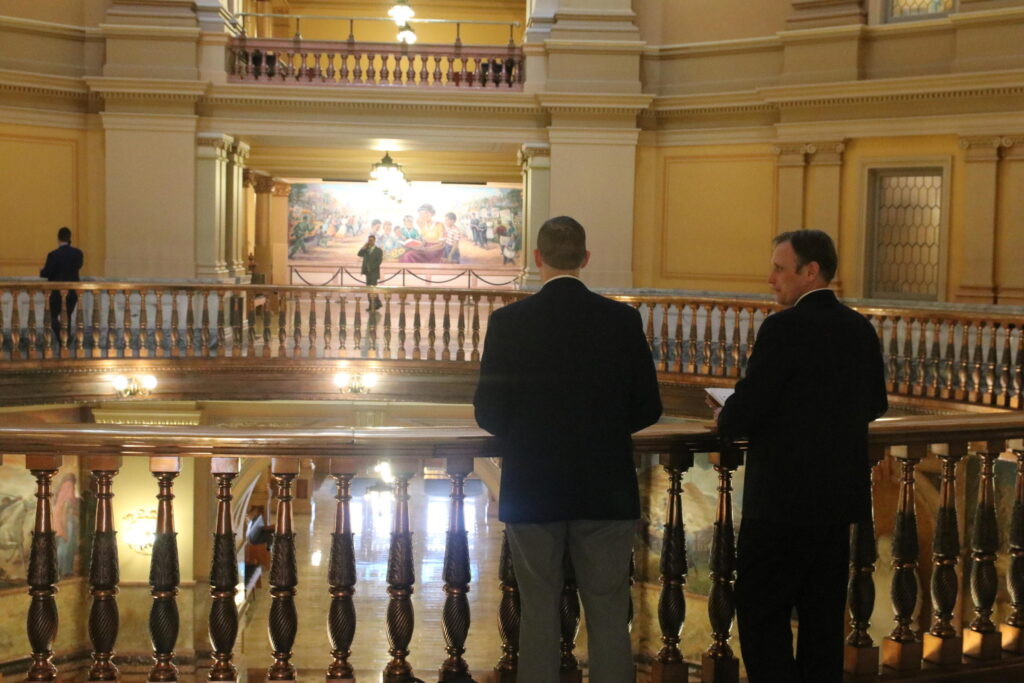
A limited number of people were allowed in the Statehouse this week to slow the spread of the coronavirus, but staffers, lobbyists and lawmakers still found time to chat at the rail. (Photo by Daniel Caudill, Kansas News Service)

by Stephan Koranda, Jim McLean and Daniel Caudill, Kansas News Service

Topeka, Kansas — The week started with a Kansas House Democrat making an unusual request to not just his fellow lawmakers on both sides of the aisle, but to the Lord: “Please nudge our counterparts in the Senate. Please help them to work with a little more urgency.”

With the threat of the new coronavirus growing by the day — businesses were shutting down, universities moving fully online — legislators knew time was running out to pass the state’s budget for the next fiscal year. The action was pretty much restricted to the Statehouse’s document room and the chambers. No visitors or school groups in the halls of the Capitol, the hearing rooms empty, the whole place a reminder of how quickly things changed.

A week before, Kansas House leaders had sent the $19.9 billion budget straight from the Appropriations Committee to a joint committee of senators and representatives. The Senate’s version landed there Tuesday, the same day Gov. Laura Kelly shut down all K-12 schools until essentially August.

On Thursday, both chambers passed the final version, which included $65 million for COVID-19 response, but not without pushback from some Republican senators who thought it unwise to add spending amid a tumbling stock market.

“We don’t have fluff in this,” said Republican Sen. Carolyn McGinn, the chamber’s top budget writer. “More than anything, we took care of the social services that are going to be very much needed back in your home communities.”

The budget is headed to Kelly’s desk, her proposals largely intact, and the Kansas Statehouse will head out for an extended spring break. Statehouse leaders said they hope to return on April 27 for a veto session, during which they’d finish their work and try to settle two issues that consumed much of their attention until recently: Medicaid expansion and a proposed constitutional amendment on abortion.
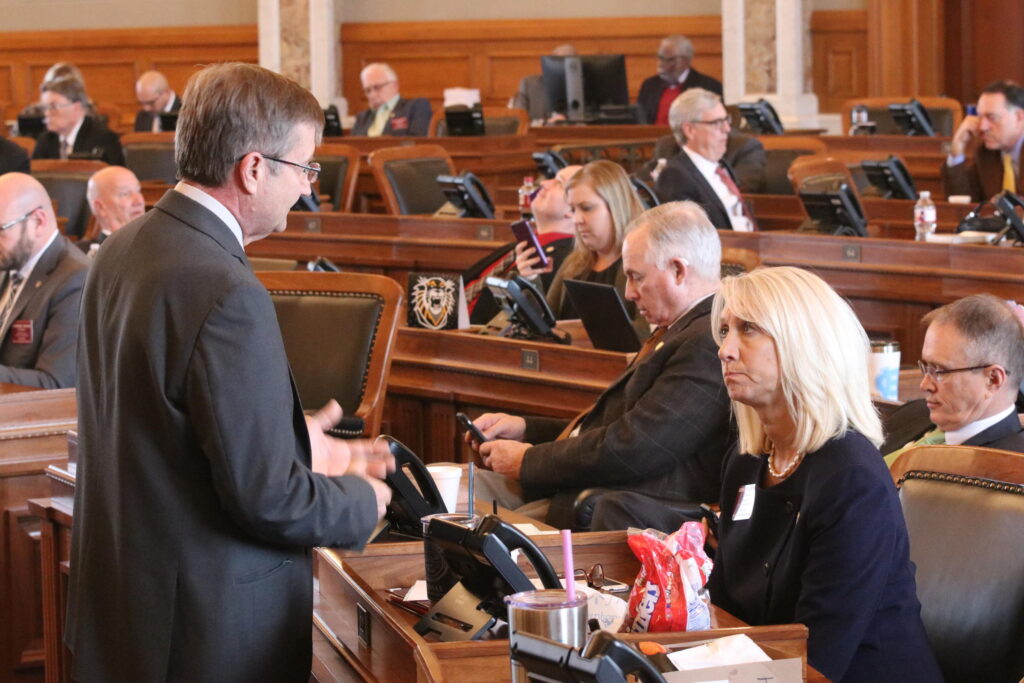
Kansas Reps. Jene Vickrey, left, and Renee Erickson chat before the House convened Tuesday. (Photo by Daniel Caudill, Kansas News Service)

Also before leaving Topeka, a majority of the House voted to kill two of Kelly’s efforts to change the makeup of some state agencies. One would have effectively reconstituted the Department of Social and Rehabilitation Services (as the Department of Human Services), which was split apart in 2012.

The other would have established an independent office to draft a state energy plan. Currently, the state Energy Office is located at the Kansas Corporation Commission, the state agency that regulates utilities. It has only one part-time employee.
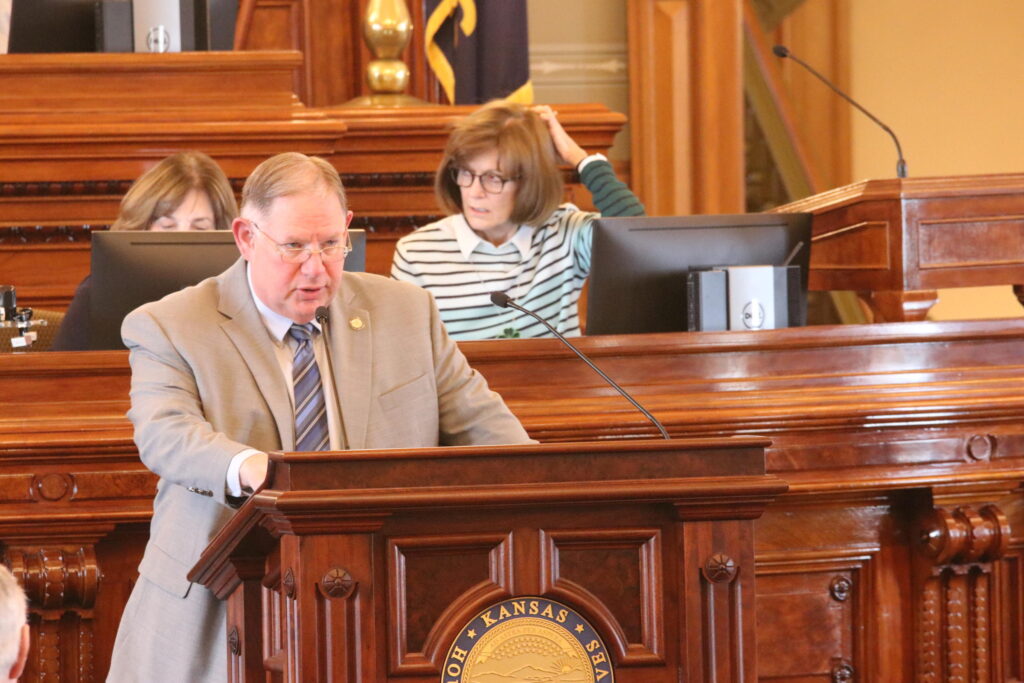
Kansas House Majority Leader Dan Hawkins spoke to House members Tuesday about loosening unemployment guidelines because of the coronavirus pandemic. (Photo by Daniel Caudill, Kansas News Service)

But the fear of COVID-19 spreading quickly through the state and the U.S. — and the concurrent feelings that state leaders were overreacting — pushed the session to an unusual moment in history. Lawmakers extended unemployment benefits to 26 weeks in response to business closures and extended judicial branch deadlines.

House Speaker Ron Ryckman said that the $65 million for coronavirus-related efforts ($15 million for the Division of Emergency Management and $50 million into a fund controlled by a panel of lawmakers) was key.

“We prioritized the things that we wanted to make sure that we could do,” he said, “and then give us flexibility going forward.”

But Kelly’s decision to close K-12 schools and limit gatherings to 50 people or fewer drew ire from some lawmakers.

“I think we’re closing our state down,” Republican Sen. Rob Olson said. “We’re creating more panic and more fear. We’re cheating these kids.”

But Democratic Sen. Mary Ware told senators that she had met with someone who, turned out, had been exposed to a now-confirmed coronavirus case, was showing symptoms and being tested.

“This is not something to take as theoretical, certainly not as a hoax,” she said. “This is real.”
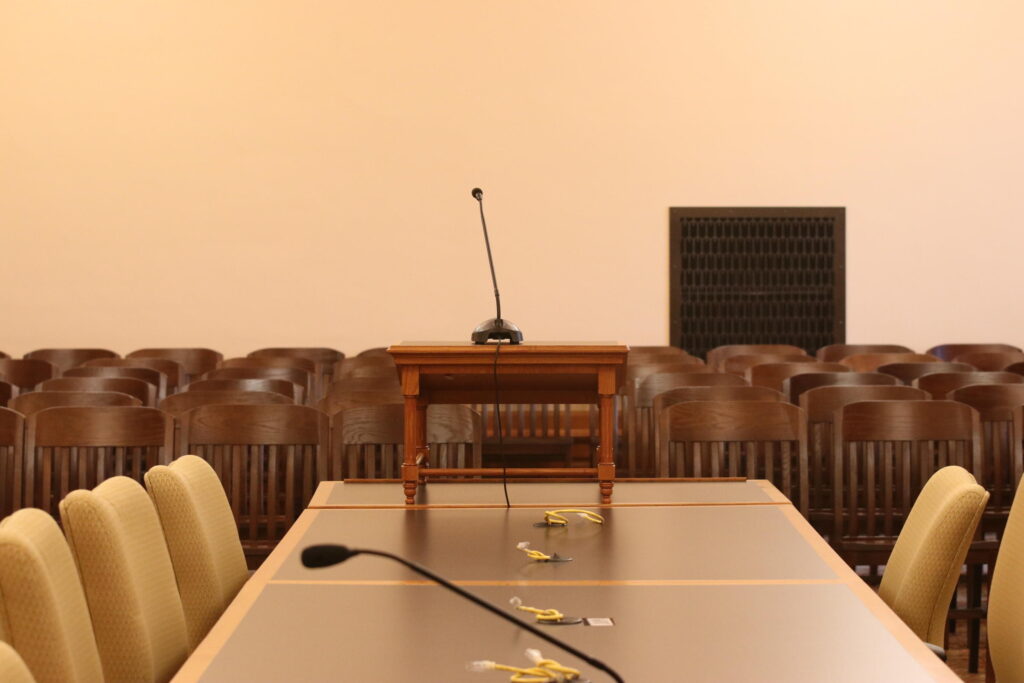
Hearing rooms throughout the Kansas Statehouse looked like this, as lawmakers worked on the budget to try to leave for break early. (Photo by Daniel Caudill, Kansas News Service)

Kelly’s actions under the state of emergency declaration, good through March 27, were met with particular scorn on the Senate floor. Some senators didn’t want her to be able to seize private property, ban the sales of guns and ammunition or force people or livestock to be relocated, which are all powers provided in state law.

“We’ve got to accept responsibility ourselves,” said Republican Sen. Caryn Tyson. “We can’t rely on the government to tell us every little move to make.”

The House wanted to extend her order until January 2021. The Senate wanted to strip some of the powers and only have the declaration last through May 1.

Their compromise: Kelly will keep the powers, but legislative leaders will review her actions and choose whether to extend or revoke the declaration every 30 days after May 1.

And there was a moment of silence Tuesday for Senate President Susan Wagle’s daughter, who died at the age of 38 from cancer. Wagle was not in the Statehouse after that.
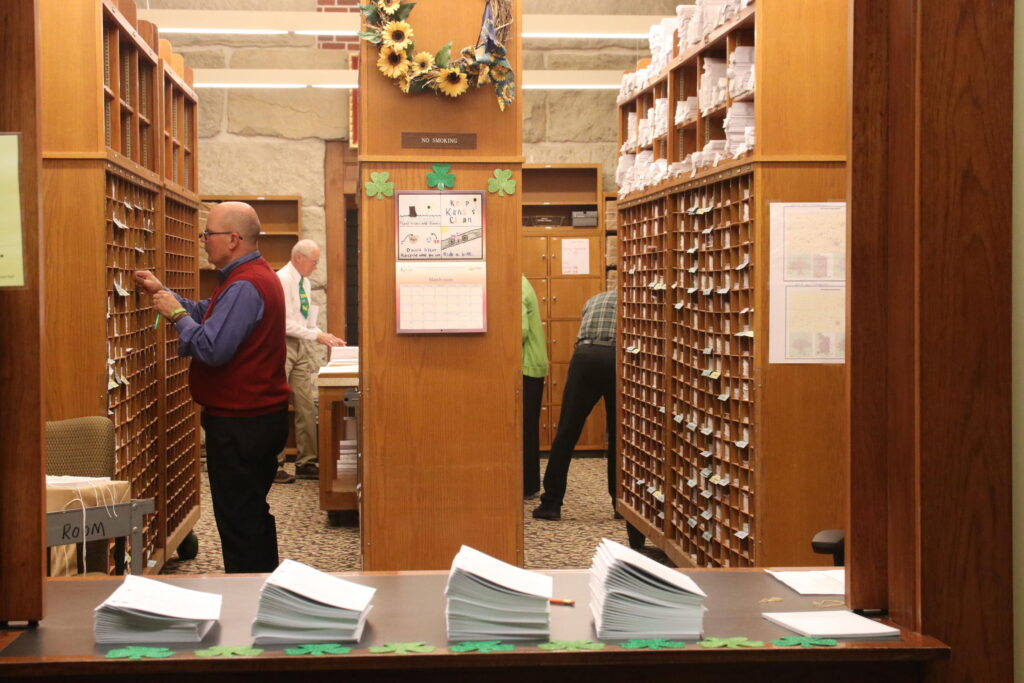
Staffers in the Statehouse’s document room were hard at work as the Kansas Legislature hurried to break early due to the coronavirus.(Photo by Daniel Caudill, Kansas News Service)

Budget details

Democratic Rep. Jim Ward said fast-tracking the budget meant most lawmakers had little input on the budget. He urged the chamber to leave enough time to really dig into spending issues at the end of the session.

“We’ve got over 50 items and almost three-quarters of a billion dollars to talk about,” Ward said, “and I think the world is going to look a lot different in a month.”

But there were some notable additions of money for agencies.

For education-related matters, lawmakers added $2.5 million more for college scholarships and $5 million for grants to improve K-12 school building security, as well as $5 million for the Cancer Center Research Fund that’s part of the KU Medical Center.

On the health care front, the budget adds $2 million more for community mental health centers and $3 million for senior care services that help older Kansans stay in their homes. With coronavirus spreading in long-term care facilities in Washington and Florida, the money could help seniors potentially avoid getting a virus that could be deadly for older people.

But some issues were pushed off for later, as Ward mentioned, like 2.5 percent raises for state employees as well as bigger raises for judicial branch employees.
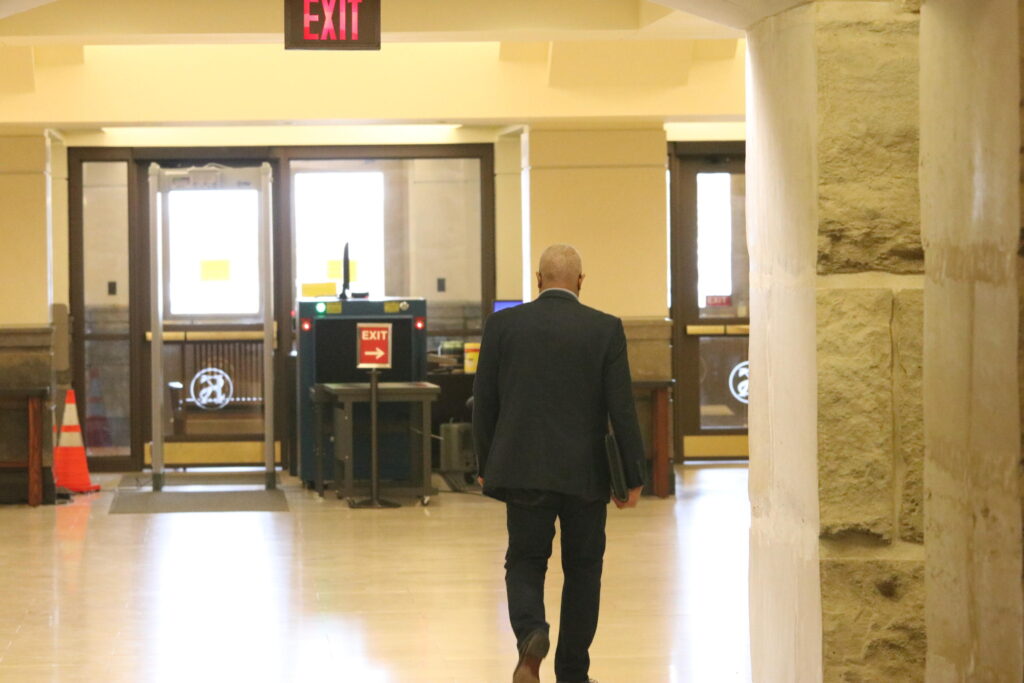
The visitor center at the Statehouse is usually bustling with students and other visitors. On Wednesday morning, it was rare to see more than two people at a time. (Photo by Daniel Caudill, Kansas News Service)

A new plan for the state’s roads
Before tackling the budget Thursday, the House and Senate approved a $10 billion, 10-year plan for the state’s transportation system. It’s based on what Kelly proposed, and unlike previous transportation plans, it mainly focuses on maintenance instead of new projects.

About half of its funding would go to repairing highways and bridges. Each of Kansas’ 105 counties will see $8 million over the next 10 years. The plans also allocates millions for broadband expansion and fixing railways.

Democratic Rep. Kathy Wolfe Moore, D-36th Dist., said it came together with compromise.

“I think it’s very important to the future of Kansas, and it’s nice that we have a little bit of good news today in the face of everything else we’re facing,” Wolfe Moore said.

If signed by the governor, the measure goes into effect on July 1.
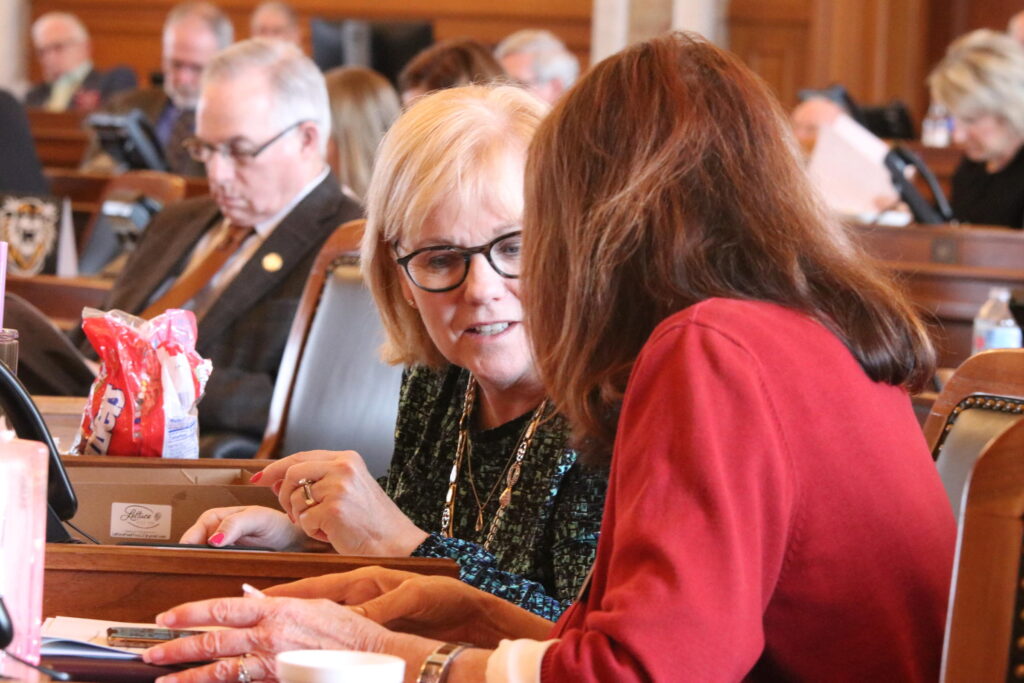
Kansas Reps. Susan Concannon, left, and Suzi Carlson chat before the House convened Tuesday. (Photo by Daniel Caudill, Kansas News Service)

New agencies off the table

Kelly had wanted to combine the troubled Department for Children and Families (foster care, federal food aid and other welfare programs) with the Department for Aging and Disability Services (mental health and programs for elderly and disabled). Her proposal also would have wrapped in juvenile justice services that are currently overseen by the Department of Corrections.

But once the idea reached the House floor on Wednesday, Democrats accused Republicans of rejecting the changes for strictly political reasons.

Reacting to arguments against the creation of an independent energy office, Democratic Rep. John Carmichael of Wichita said, “This is pure, blatant partisanship.”

“It’s the party of “no” sitting over here,” Carmichael added, gesturing to the side of the chamber occupied by Republicans.

But Republicans insisted their opposition stemmed from the lack of detail in the governor’s proposals, not politics.

“It’s about control and moving money around,” Republican Rep. Leo Delperdang said.

Republican Rep. Will Carpenter called the proposed Department of Human Services “just a bad idea.”

While “disappointed,” Kelly said Wednesday that the increased demand for government services triggered by the coronavirus outbreak would have made it difficult to set up a new state agency.

“It may be in some ways a blessing,” Kelly said.

Even so, Kelly maintains that consolidating social service programs under one roof would streamline the delivery of services and “make it easier for Kansans” to navigate the bureaucracy.

“It is something I want to happen but we’re willing to bring that back to the Legislature next year,” she said.
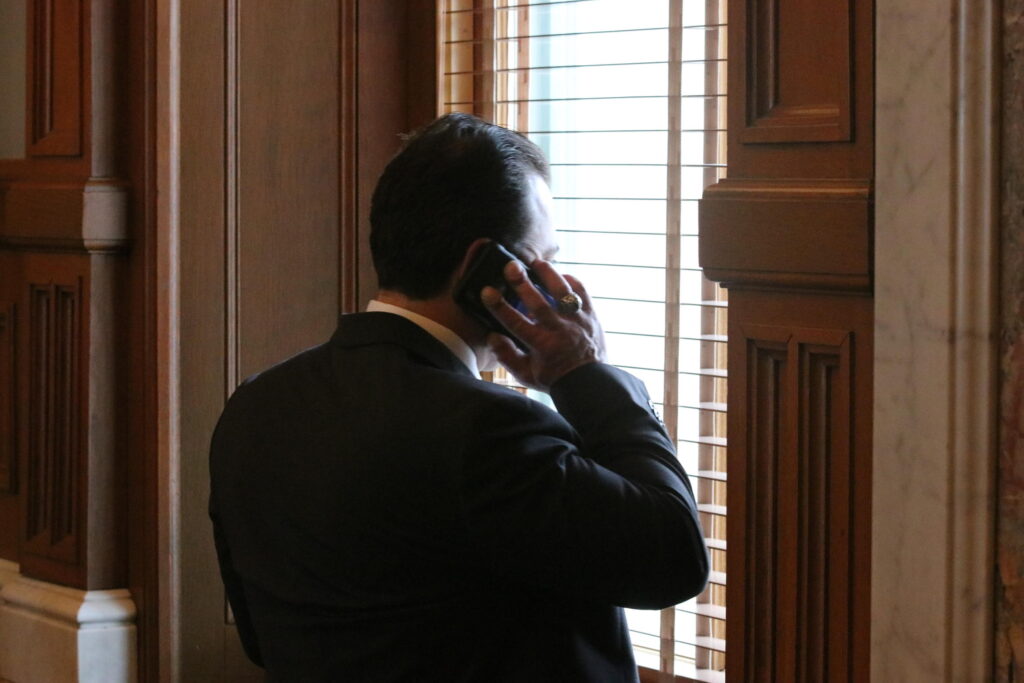
Rep. Troy Waymaster took a phone call before the House convened on Tuesday. (Photo by Daniel Caudill, Kansas News Service)

What comes next?

Just a few weeks ago, lawmakers had hit the midpoint of the session, sending the other chamber bills they thought should reach Kelly’s pen, things like sports gambling, a public voice in property taxes and making it easier to get a suspended driver’s license back.

What they were absolutely deadlocked on, and what may return to the forefront if the session is able to resume, were two things: Expanding KanCare to an estimated 130,000 low-income Kansans, and a proposed amendment to strip what the Supreme Court said was the right to an abortion out of the state constitution.

Despite a Republican Senate leader joining with Kelly in calling for a Medicaid compromise, some Republican leaders oppose it. And when the House narrowly rejected a decision to put the proposed abortion amendment on the August primary ballot, both efforts ground to a halt.

Republican Speaker Pro Tem Blaine Finch thanked his fellow House members Thursday for working to put aside differences to craft solutions in the face of the coronavirus, and urged them to keep the spirit of bipartisan compromise alive.

“Our fellow Kansans are facing hardships, and from everything we’re told, those hardships will increase in the coming weeks,” Finch said. “We’re going to get through this as we have time and time and time again in this state — together.”

Stephen Koranda is the Statehouse reporter for Kansas Public Radio and the Kansas News Service. You can reach him on Twitter @kprkoranda.
Jim McLean is the senior correspondent for the Kansas News Service. You can reach him on Twitter @jmcleanks or email jim (at) kcur (dot) org.
Daniel Caudill covers the Statehouse. You can reach him on Twitter @byDanielCaudill.

The Kansas News Service is a collaboration of KCUR, Kansas Public Radio, KMUW and High Plains Public Radio focused on health, the social determinants of health and their connection to public policy.
See more at https://www.kcur.org/post/kansas-gets-budget-and-lawmakers-take-early-leave-session-changed-coronavirus.

UG Commission unanimously approves emergency measures to deal with COVID-19

In a special meeting on March 19, the Unified Government Commission unanimously approved several emergency measures to deal with the COVID-19 pandemic.

Nine positive COVID-19 cases have been reported in Wyandotte County on March 19, according to health officials.

The mayor, UG administrator and Health Department staff made remarks at the meeting, while the UG Commissioners phoned in their comments and votes. The meeting was broadcast on UGTV, with a viewing area for the public in the City Hall lobby to accomplish social distancing.

The commission voted unanimously to extend the mayor’s emergency declaration to May 18.

The commission also unanimously approved an amendment that makes it a misdemeanor to violate, refuse or fail to comply with a written order of the health officer, Board of Health or director of health.

Those who violate the order could be fined a maximum of $500, according to UG officials.

The Sheriff’s Department or Police Department could make arrests, and violators could be prosecuted under the action, according to the UG’s chief attorney.

Also, the commission unanimously voted to authorize the county coroner or the UG administrator to appoint one or more deputy coroners if needed.

Then, meeting as the Wyandotte County Board of Health, the commissioners unanimously passed a resolution to ratify and support the emergency public health orders issued by Dr. Allen Greiner, chief medical officer, on March 16 and March 17. Those orders restricted gatherings to 10 or fewer, and also closed restaurants, bars, taverns, movie theaters and casinos, to try to reduce the spread of COVID-19. The establishments could continue providing takeout food.

Mayor David Alvey said the point of it all is to “flatten the curve,” to to avoid a spike that would overload the health care system.

“The recent decision by us and by Johnson County, Jackson County and Kansas City, Missouri, to close restaurants and bars is really an attempt to get out in front of it, because that’s what is happening elsewhere,” Mayor Alvey said.

Doug Bach, UG administrator, said he wanted to make sure the first-providers in the field are protected, also. They are working with Kansas and others to try to get supplies, he said.

This week, the UG began closing government offices. Effective Monday, they will effectively close operations to the public, including the motor vehicle area, and tags, where renewals will be available online, he said. The local district courts and municipal courts are suspended through late April, with district courts hearing emergency cases.

City Hall, the courthouse, Neighborhood Resource Center and annex operations will not be available for the public until further notice, he said.

There will be some public meetings where the doors will open about 15 minutes before the start of the meeting, he said, and they are working on other measures for public participation.

The public may walk into the police headquarters, South Patrol and Midtown Patrol to make reports, and they will be in glassed-in areas for security, he said.

Transit operations will continue through the metro area, coordinating with others in the Kansas City area, he said.

He said more information is on the UG’s website at Wycokck.org/COVID-19.

A collaborative group of leaders, health groups, hospitals, social service agencies, the three cities and others has been meeting to discuss the approach the UG should take to COVID-19, Mayor Alvey said.

He said they are beginning teleconference calls with the Kansas City, Kansas, Chamber of Commerce, Bonner Springs Chamber of Commerce, Wyandotte Economic Development and others.

They also will be conducting teleconference calls with local pastors on how to keep groups under 10.

Terrie Garrison, deputy director of the UG Health Department, gave an update on COVID-19 in Wyandotte County.

She said there were nine positive cases in the county as of March 19, and that the Health Department is investigating all of the contacts in the cases. They are determining if the persons need to self-quarantine or if there is a need for testing.

The Health Department is also setting up a process for testing, she said.

Those who have primary care doctors should call their doctor’s office first for information about whether they need to be tested, according to health officials.

A safety net provider, Southwest Boulevard Family Health Clinic, has set up drive-through safety net COVID-19 testing today for those patients who go to safety net clinics, according to Garrison.

The patients have to go through a safety net clinic and be assessed before they can drive-through for a test, she added.

Dr. Allen Greiner, the chief medical officer for Wyandotte County, said four COVID-19 drive-through tests were administered to the safety clinic today. Most of those tests will go to private labs, he added.

He said the Health Department is trying to work closely with the testing site to help with protocol and follow-up. They also will do contact investigation and tracing with the individuals who test positive.

“We’ve increased the size of our contact investigation activities,” Dr. Greiner said.

Volunteers with Heart to Heart International, who have done work with infectious diseases previously, are assisting, he said.

He added that Johnson County has decided not to do contact tracing because they have community spread, and have some positive cases where they cannot determine where the person contracted the disease.

He said he expected that Wyandotte County would continue to do its contact tracing work indefinitely.

Those who have contacts with positive COVID-19 cases are being asked to go into a 14-day quarantine, he said. Some of these cases will be “presumptive positive,” he added.

There has been a lack of testing previously, and having some community testing will help the Health Department, he believes. The community has a number of vulnerable people and health officials want to do everything to limit the spread of COVID-19.

Since there seems to be a lack of tests, local health officials will also rely on self-reporting.

Garrison said people may self-report their symptoms and severity to the Health Department, and health workers will get back with them, follow up and advise them. There will be a form available in the future on the UG’s COVID-19 website for self-reporting. Some of those who are self-reporting could be assumed to be presumptive positive.

Garrison said that would help them with “hot-spotting” different areas in the community to see where there might be pockets of infection.

Wyandotte Health Foundation is helping with funding sources for the safety nets, she said.

A former Health Department epidemiologist has come back to help with the effort, she added.

Challenges include making sure there are enough supplies for the Health Department and safety net providers, EMS workers and police officers, she said, and testing supplies.

Those who have a cough and fever should stay home unless they are going to their health care providers, she said. They should call first before they go. She also emphasized washing hands, keeping six feet away from others, cleaning surfaces and not shaking hands.

“It’s been amazing to watch the cooperation and teamwork that has transpired,” Commissioner Melissa Bynum said. “This community has shown us, once again, how resilient we are.”

To view the meeting, with more comments from the commissioners, visit https://www.youtube.com/watch?v=w3bWe5oKFJU.

For more information, visit https://www.wycokck.org/COVID-19.

KDOT to work on bridges and patch potholes on Friday in Wyandotte County

UPDATE: the pothole patching has been rescheduled.

The Kansas Department of Transportation will conduct bridge work and pothole patching from 9 a.m. to 3 p.m. Friday, March 2, in Wyandotte County, weather permitting.

Pothole patching projects are expected to have alternating lane closures and be completed in one day, according to KDOT.

Northbound I-635 over K-5 has the right lane closed for bridge work indefinitely.

Pothole patching projects:

• Eastbound and Westbound I-670 from I-70 to the Missouri state line.

• Eastbound and westbound I-70, from KTA – 61st Street to the Missouri state line.

• Northbound and southbound I-635 will have the right lane closed through Wyandotte County to the Missouri state line.

• Northbound and southbound I-435, from the Kansas River to the Missouri River.

Traffic will be controlled by mobile lane closures using trucks with arrow boards and digital message boards, KDOT stated.

A KDOT spokesman urged all motorists to be alert and obey the warning signs when approaching and driving through a highway work zone. To stay aware of all road construction projects across Kansas go to www.kandrive.org or call 5-1-1. Motorists should drive safely and always wear their seat belt, according to KDOT.