
KCK school board candidates lambaste block grant bill

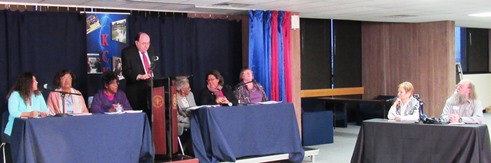
At a candidate forum Wednesday evening, candidates for the KCK school board spoke. From left, Maria Ysaac, Rep. Val Winn, incumbent Brenda Jones, moderator Murrel Bland, incumbent Gloria Willis, Irene Caudillo and Janey Humphries. To the right are Linda Pendleton, who asked questions, and incumbent George Breidenthal. (Staff photo)

by Mary Rupert
There was no disagreement Wednesday evening among the seven Kansas City, Kan., school board candidates on the school block grant bill passed within this past week by the Kansas Legislature. The candidates roundly criticized it.

The block grant is designed to give school districts the same amount of money as they receive now for the next two years. The bill passed the House and Senate and went to the governor for a signature.

The seven KCK school board candidates made their remarks at an election forum at Kansas City Kansas Community College, sponsored by Business West, Downtown Shareholders, Historic Northeast Midtown Association, Armourdale Renewal Association, and the community college. About 100 persons attended. Asking questions of the school board candidates was Linda Pendleton, former KCK school board member who is the Armourdale Renewal Association executive director.

“The problem is, the Kansas City, Kan., district is a growing district,” said George Breidenthal, a school board incumbent. The board members fear that if their district adds students, which requires more teachers and other funding, it will not receive enough money for the additional students.

Some expect the new block grant funding bill to be challenged in court if it becomes law. On Tuesday, March 17, the Kansas attorney general filed an appeal to the a judicial panel’s finding that school funding in Kansas is inadequate in the Gannon case.

Breidenthal said the last he heard, the KCK district could lose up to $9 million under the new legislation. Right now the board is trying to figure out the school district’s budget, and has no idea of what to expect. The KCK district may get the same amount of funding that it received in 2003, he said. It was like trying to live on the same amount of funds that you had in 2003, he added.

Janey Humphries, a candidate for the school board, said the district is now expected to do more with less. Block grants will hurt the district because it is a growing district, she said. The district receives more funding for low-income, non-English speaking students, but that may change under the new legislation. There are about 9,000 non-English speaking students in the district, who are expected to perform well on tests in only one year, she added.

“What you’re seeing at the Capitol is definitely an attack on public education,” said Irene Caudillo, a school board candidate. The block grant was not good for the district, and legislators are trying to balance the budget on the backs of the children, she said.

“What we need to do is to make sure we continue to advocate,” she said. “We need to make sure that this does not happen.”

Gloria Willis, a member of the school board for 20 years, said the block grant reminds her of being put in a box. The box closes the district in, she said.

“I’m an advocate of public education,” she said. “We need to do things that will benefit the children in Kansas City, Kan.”

Brenda Jones, incumbent board member, pointed out that costs have gone up over the years as enrollment increases. The consumer price index was up 22.9 percent, enrollment increased 11.4 percent, the at-risk count is 23.2 percent and the bilingual number is 62.7 percent, she said.

“Our at-risk kids will be at risk even more,” Jones said. “They will be forgotten.”

Rep. Val Winn, D-34th Dist., a KCKCC professor who is running for the school board and plans to also serve at the same time in the Legislature, said the amount of funding to KCK will be reduced in the block grant. The funding amount on paper looks like more money, but it includes pension funding, not money that can be used in the classroom, she said.

“The block grant was a coup,” she said, and it will last as long as those who passed it are in power. There is still a last bastion of protecting the constitutionality of adequacy of funding, she added.

The Wyandotte County legislators who are Democrats voted against the block grant bill.

Maria Cecilia Ysaac, also a candidate for the school board, said, “It is sad and it makes my stomach turn that the legislators that said they were going to protect our education and that wanted the best for Kansas are doing this to our students, the most vulnerable, the ones that can’t defend ourselves. We are here to defend them. This school board, I believe, has an obligation to fight back any way it can, by encouraging our children to be civically active, to speak out, to march, to make phone calls, and to demand that their representatives represent their interests.

“Shame on them, but shame on us if we don’t do something about this and vote these people out,” Ysaac said.

Janet Waugh, State Board of Education member, 1st District, who attended the meeting, said afterward that she had “tweeted” this message right after the vote: “Today I say shame on you to the House members who voted yes” on the block grant bill.

Waugh said that the school districts in Wyandotte County, and most school districts in the state, were not in favor of the block funding bill. It did have some support from the Blue Valley and Shawnee Mission school districts in Johnson County, she added. One elementary school to the north of Easton may have to close because of the funding.

The candidate forum, with more comments from the KCK school board candidates and other candidates for office, will be shown on the KCKCC cable television channel. The election is April 7.

Send your news and comments to Wyandotte Daily at news@wyandottepublishing.com.
I-70 multi-bridge repair project to begin in Wyandotte County

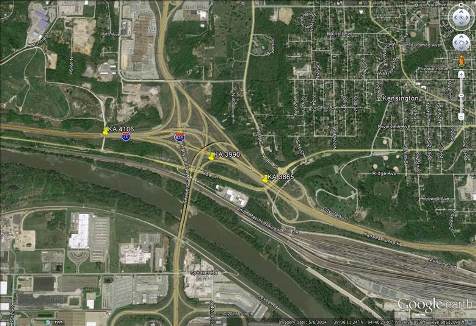
KDOT graphic
KDOT graphic

On Wednesday, March 25, weather permitting, a multi-bridge repair project will begin on eastbound and westbound I-70 in Kansas City, Kan., according to the Kansas Department of Transportation.

Project work includes complete replacement of the decks over the eastbound and westbound I-70 bridges over Kaw Drive; joint repair work on southbound I-635 to eastbound I-70 ramp bridge; and mill, patch and overlay work on the eastbound I-70 bridge over Quarry Road. Work will take place during daylight hours (sunrise to sunset), Monday through Friday with some occasional Saturday work.

Beginning at 9 a.m. on Wednesday, March 25, the following ramp closures will begin: northbound and southbound I-635 to eastbound I-70 and eastbound I-70 to Park Drive-Kaw Drive.

Marked detours will be provided. The northbound and southbound I-635 to eastbound I-70 ramp closures will be in place, 24/7 round the clock, throughout the project duration. The eastbound I-70 to Park Drive-Kaw Drive ramp will reopen to traffic in July 2015.

At the same time on Monday, March 25, eastbound and westbound I-70 from just west of I-635 to just east of Kaw Drive will be reduced to two 11-foot lanes with no shoulders, 24/7 round the clock, throughout the project duration. There will be a 55 mph posted speed limit on I-70 through the work zone throughout the project duration.

Project work will be completed in several phases with varying traffic impacts, according to KDOT. Additional phasing and project-related traffic closures will be sent out in advance under separate cover.

Project construction information, including general phasing, traffic impacts and marked detour route maps can be viewed at: I-70 over Kaw Drive Multi-Bridge Construction Project information. Updated daily traffic information for this project and for the entire Kansas City metro area can be viewed at: www.ksdot.org/kcmetro/laneclose.asp.

Drivers should expect delays and must allow extra time during their daily commutes. The Kansas Department of Transportation urges all motorists to be alert, obey the warning signs, and slow down when approaching and driving through the project work zone.

Clarkson Construction, Kansas City, Mo., is the primary contractor on this multi-bridge repair project with a total contract cost of $8 million. Project work is scheduled to be completed in December 2015, weather permitting.

This project is funded by T-WORKS, the transportation program passed by the Kansas Legislature in May 2010.

Tobacco-funded groups push back on proposed tax

Those with ties to industry speaking to legislators include Heartland Institute, former ATF agent
by Andy Marso, KHI News Service
Several legislators and lobbyists filed into a committee room Monday in Topeka for a video presentation, toting slices of pizza and cans of soda.

The lunch was sponsored in part by Altria, the parent company of Philip Morris USA and other tobacco sellers.

The presentation was courtesy of Rich Marianos, a former agent with the federal Bureau of Alcohol, Tobacco, Firearms and Explosives, who told those gathered that when states increase tobacco taxes well above their neighbors’ rates, it opens up an enticing black market.

“When there is that tax discrepancy, it creates a world for criminals and smugglers,” said Marianos, who works as a consultant for Altria.

Tobacco companies have largely avoided trying to directly influence the Kansas Legislature’s ongoing debate over whether to raise cigarette taxes by $1.50 per pack to cover a portion of the general fund’s projected $650 million budget hole. But groups and individuals funded by the industry have filled that role, warning legislators about what they say would be the consequences of the tax hike.

Marianos is one of the headliners — a 27-year ATF veteran who speaks of the history of cigarette smuggling from low-tax states like North Carolina to high-tax states like New York from the position of someone who has been on the front lines investigating it.

“New York is just out of control,” Marianos said. “It’s $14 for a pack of cigarettes, it’s $140 for a carton. So some of the less-taxed states make it extremely lucrative for criminals in New York.”

Tracy Russell, representing the anti-tobacco coalition Kansans for a Healthy Future, questioned whether the tobacco companies Altria represents are truly concerned that tobacco taxes increase smuggling, because they get paid no matter in which state the cigarettes are purchased.

Russell said she thinks the companies’ real concern might be that increased tobacco taxes are proven to reduce smoking rates, thereby reducing profits for the industry.

She said there’s little evidence that tobacco smuggling is a “widespread problem” throughout the country, which is why the industry tends to point to the Northeast corridor.
“The industry focuses mainly on areas that have a much higher tobacco tax than what is being proposed in Kansas and does not present an accurate comparison of what could happen in Kansas,” Russell said.

Marianos said smuggling is also a problem in the Midwest. But he said the force behind it in the middle of the country is not necessarily that cigarette taxes in some Midwestern states are too high, but that the tax in Missouri — the lowest in the country at 17 cents per pack — is too low.

“Missouri’s doing no favors for anybody,” Marianos said.

The Heartland Institute, a Chicago-based think tank with documented ties to the tobacco industry, also is weighing in on the Kansas tax proposal.

The institute’s John Nothdurft has composed a webpage that states the tobacco tax will fall disproportionately on low-income Kansans, harm businesses that rely on tobacco taxes and fail to bring in the revenue expected as customers quit or buy from neighboring states.

“Tobacco taxes rarely bring in the revenues their proponents say they will,” Northdruft writes.

The page provides a series of links to other documents questioning the effectiveness and wisdom of tobacco taxes. A disclaimer at the bottom of the page warns “Nothing in this Research and Commentary is intended to influence the passage of legislation” but also says the institute can make experts available to testify or speak to a legislative caucus.

The institute’s position that cigarette taxes are not a reliable source of revenue runs counter to research presented to legislators earlier this month by Frank Chaloupka, an economics professor from the University of Chicago.

Chaloupka, whose research on the proposed Kansas increase was funded by a grant from the National Institutes of Health, said he has studied tobacco tax increases in many states for more than a decade. His research shows that states that raise the tax bring in new revenue while also saving on health care costs because some residents will quit, but not in numbers large enough to offset the tax revenue gain from those who continue smoking.

Russell said those should be the driving factors that legislators consider when looking at the tax increase. She added that smuggling can be minimized with the use of high-tech tax stamps and better enforcement.

“Not enacting a tobacco tax increase is an extreme answer to a minor concern for which there are other remedies,” Russell said. “It is time to increase the only tax that comes with health benefits.”

The nonprofit KHI News Service is an editorially independent initiative of the Kansas Health Institute and a partner in the Heartland Health Monitor reporting collaboration. All stories and photos may be republished at no cost with proper attribution and a link back to KHI.org when a story is reposted online.

– See more at
http://www.khi.org/news/article/tobacco-funded-groups-push-back-on-proposed-tax#sthash.xUTjIUwo.dpuf