
KCKCC athletes donate blood at mini blood drive

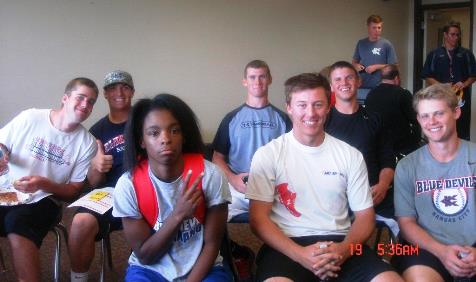
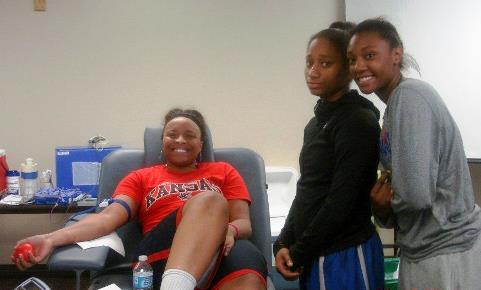
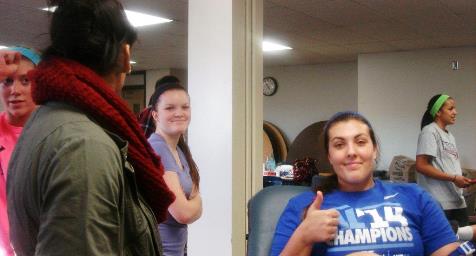
Kansas City Kansas Community College athletes donated blood recently  for the Community Blood Center. (KCKCC photo)
Kansas City Kansas Community College athletes donated blood recently for the Community Blood Center. (KCKCC photos)

Basketballweb

Volleyballweb
by Kelly Rogge

For the first time, blood drives were held on both the Kansas City Kansas Community College main campus as well as KCKCC-TEC, a plan that worked out well for the student athletes at KCKCC and the Community Blood Center.

“The athletes and nursing students are our biggest supporters when it doesn’t conflict with their practices, games or nursing clinicals,” said Linda Sutton, director of student activities at KCKCC. “Valerie Stambersky (women’s basketball coach at KCKCC) contacted me and asked if the time could be extended because her team wanted to donate, but had missed the time (on the main campus) because of practice.”

In addition to Stambersky, Sutton said KCKCC baseball coach Steve Burleson had sent me an email stating that his team could not donate because they had a game on the original day of the blood drive. After speaking with the Community Blood Center and discovering that it was not possible to extend the day beyond the allotted time, Sutton said they came up with an alternative day, Oct. 17.

“The mini blood drive was a huge success,” she said. “The athletes donated 24 units (of blood) in a three-hour period.”

During the Oct. 15 blood drive, KCKCC collected 53 units, bringing the combined donations of the main campus and the student athletes to 77 units of blood. Sutton said the goal for the main campus was 54 units. The total units from the TEC are not yet available.

“The college has partnered with the Community Blood Center for over 35 years because they are the main provider of blood for the 75 hospitals in the area,” Sutton said. “They (the Community Blood Center) were impressed that our athletes would spend their Friday afternoon donating blood.”

Sutton said she is thankful to all of the coaches, athletes and the entire KCKCC Athletic Department for stepping up to donate “life-saving blood.”

“Also, a big thank you to Jeff Sixta and the Buildings and Grounds staff for their quick setup and getting the room ready for the mini blood drive,” she said. “And most of all, we were proud to dedicate these blood drives to Kelly Fehlhafer, who is currently receiving platelet transfusions. Kelly is the wife of Tom Fehlhafer who works at the TEC campus.”
Kelly Rogge is the public information supervisor with Kansas City Kansas Community College.
New curbs and sidewalks coming to Turner area

Commissioner Angela Markley is holding a special ribbon-cutting event near Matney Park, at 42nd and Shawnee at 10 a.m. Wednesday, Oct. 22, to celebrate the completion of a Commissioners’ Neighborhood Infrastructure Project (CNIP project) in her district. Markley will be joined by the students from Junction Elementary School.

The ribbon-cutting will be open to the public.

New sidewalks were recently completed from the Junction Elementary School entrance along Shawnee Drive, connecting with the walking trail that ends at Matney Park. Although the event will feature Junction’s new sidewalks, Markley will also draw attention to new ADA compliant sidewalks and curbs along 55th Street from Hagemann to Oak Grove Road, and to lighting improvements at Turner Community Walking Park.

“The families of Junction Elementary students are very appreciative of the completion of this project. It brings us comfort to know our students can walk safely to school on the new sidewalks,” said Junction Elementary Principal Kristen Shipp.

Trying to figure out how to upgrade and finance an aging infrastructure has been a challenging and complex debate for many local governments throughout the nation. The Unified Government Board of Commissioners committed $4.4 million to improving and updating aging streets, curbs, and sidewalks in eight districts.

“Sidewalks are consistently a priority for our residents. They are a sign of healthy, family-friendly neighborhoods. But traditionally, there has not been a funding mechanism for new sidewalk projects,” Markley said.
The creative financing for these projects comes from the Commissioners’ Neighborhood Infrastructure Project (CNIP), funded through the Public Safety and Community Infrastructure Sales Tax, which was overwhelmingly passed by voters in April of 2010.

“The CNIP program created an avenue to address this community need, and we continue to look for innovative ways to complete sidewalk projects countywide,” Markley said.

The commission approved a process that allows it to use sales tax revenue to pay for projects commissioners have selected within their individual districts. The funding would be allocated for two rounds in 2013 and 2015, with planning years in 2012 and 2014. The projects are approved by a vote of the full commission. The District 6 CNIP project cost approximately $210,000.

“These projects were chosen after receiving input from more than 200 residents through email and neighborhood meetings and events,” Markley said. “I am proud to have completed projects that were a priority for residents, and that would not have been funded without this unique CNIP program.”

“Our Junction Elementary PTA joins us to express our delight to know our families can walk to night events, such as musical performances and PTA Bingo and Carnival. Several Turner community members, along with the Turner Recreational Commission, use the sidewalks to access the baseball field as teams practice and play games in the evening,” Shipp said.

“Our Public Works staff have been working hard to improve the infrastructure throughout our community,” said Mike Tobin, director of public works. “We appreciate the collaboration from our commissioners and the overwhelming support from our residents as we work together to provide vital community services and programs that continue to improve our infrastructure.”

– Story from Edwin Birch, public information officer, Unified Government

Donnelly College’s president shares vision

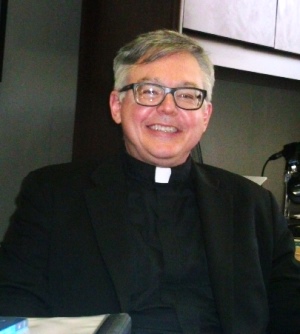
Monsignor Stewart Swetland, president of Donnelly College, recently discussed the vision for the future of the college. (Photo by William Crum)
Monsignor Stuart Swetland, president of Donnelly College, recently discussed the vision for the future of the college. (Photo by William Crum)

by William Crum

The president of Donnelly College, Monsignor Stuart Swetland, recently shared his vision of the future for the college.

In an interview, Monsignor Swetland talked about what Donnelly College is truly about.

“We are in the business of forming men’s and women’s lives to live out their vocation, to serve the community through excellence,” he said.

By doing so, the students there have a greater chance of succeeding in life, he said. For many students this is their chance to get a higher education.

A lot of people regard Donnelly College as one of the best-kept secrets in Kansas City, Kan., he said. Donnelly’s student-to-teacher ratio is very low, which causes the students to do better in the long run, he believes.

“At Donnelly, as you know, we have a lot of programs in fact Donnelly has a few that are four-year programs. The students here are taught not only communication skills, but reasoning skills as well, which makes students who graduate from here more valuable in the workplace as a whole,” he said.

He added that Donnelly wants to encourage students to follow their dreams, whatever it may be.

The mission of Donnelly College is simple, to provide education and community services with personal concern for the needs and abilities of each student, especially for those who might not otherwise be served.

For more information about one of the best-kept secrets in Kansas City, Kan., give Donnelly College a call at 913-621-8700 or go to the website, www.donnelly.edu.